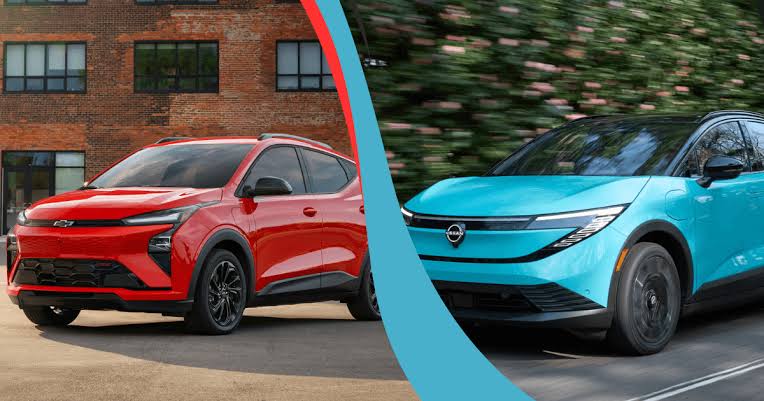
For years, the cheapest new EVs came with a catch: not much range, slow charging, or a plug that didn't work at most fast chargers. That's changed. The redesigned 2026 Nissan Leaf and the returning 2027 Chevrolet Bolt both start under $30,000, both have native NACS ports that work at Tesla Superchargers, and both go more than 260 miles on a charge.
They're aimed at the same buyer but built around different priorities. One offers more range and a roomier body, the other charges faster and costs a little less. Here's how they compare, and which one suits which driver.
Prices and Trims
The Leaf starts at $29,990 for the S+ trim, with the SV+ at $34,230 and the Platinum+ at $38,990, before a destination charge of about $1,495. Nissan has also discussed a lower-cost S trim with a smaller 52 kWh battery, so check what your dealer actually has, since entry-level trims sometimes arrive later or in small numbers.
The Bolt starts at $28,995 for the LT and $31,600 for the sportier RS, before destination. Chevrolet has described the 2027 Bolt as a limited run, so availability may be tighter, particularly early on.
At their base prices, they're within about $1,000 of each other. Both are the kind of EV that was hard to find at all a few years ago.
Range and Battery
The Leaf wins on paper. Its 75 kWh battery gives the S+ an EPA-estimated 303 miles, which is remarkable at this price. Move up the range and the figure drops, because bigger wheels and extra equipment cost efficiency: 288 miles for the SV+ and 259 for the Platinum+. That's an unusual situation where the cheapest version goes the farthest.
The Bolt uses a 65 kWh lithium iron phosphate (LFP) pack for an estimated 262 miles. LFP chemistry has real advantages: it tolerates being charged to 100% regularly better than many other chemistries, and it tends to hold capacity well over many charge cycles. It typically gives up a little performance in very cold weather, which our guide to battery degradation covers in more detail.
For daily driving, both are far beyond what most people need. The average American drives under 40 miles a day. The Leaf's extra range matters mainly on long trips or if you can't charge at home.
Charging Speed and Ports
Here the Bolt hits back. It can accept more than 150 kW on a DC fast charger and goes from 10% to 80% in about 25 to 26 minutes. The Leaf also peaks around 150 kW but takes roughly 35 minutes for the same 10 to 80% window, because it's filling a larger battery.
On a road trip, that difference is meaningful. The Leaf goes farther between stops; the Bolt spends less time plugged in at each one. Over a long day of driving, they end up closer than the raw range figures suggest.
Both have a native NACS port, so they can use many Tesla Superchargers without an adapter. The Leaf adds a separate J1772 port on the driver's side for Level 2 charging, which is handy since most home and public Level 2 chargers still use that plug. The Bolt uses its NACS port for both and includes adapter support for J1772 charging. Both charge at 11.5 kW on Level 2 at home, which is enough to refill overnight easily.
Space and Practicality
The Leaf has grown into a small crossover shape, sitting higher than the old hatchback, with a more conventional SUV look. That means easier entry, a higher driving position and decent cargo space behind the rear seats.
The Bolt keeps the tall, boxy hatchback shape the old Bolt EUV was known for, which was always its secret weapon. It's small outside but uses its space well, with good headroom and a flat floor.
Neither is a family hauler. If you regularly carry four adults and luggage, look at something larger, like the options in our best EVs under $40,000 roundup. For commuting, errands and the occasional trip with two or three people, both work fine.
Technology and Features
Both run modern infotainment systems with Google services built in, which means Google Maps and Google Assistant work natively, with charging stops built into navigation. Smartphone mirroring is where you need to check carefully: GM has dropped Apple CarPlay and Android Auto from its newer EVs, and support varies by model and model year at Nissan, so confirm on the exact trim you're considering if that matters to you.
The Bolt offers GM's Super Cruise hands-free highway driving as an option on both trims, which is unusual at this price and genuinely useful on long highway drives. It costs extra and needs a subscription after the trial period. The Bolt also supports vehicle-to-home (V2H) power, so with the right equipment it can help power your house during an outage.
The Leaf counters with newer packaging, available heat pump climate control on higher trims for better winter efficiency, and a battery warranty that explicitly guarantees capacity retention: 8 years or 100,000 miles, with a promise to keep at least 9 of the 12 bars on the capacity gauge.
Running Costs
Charging costs are similar, since efficiency is close and both are fairly light. At the US average of about $0.16 per kWh and roughly 3.5 to 4 miles per kWh, expect somewhere around $600 to $700 a year for 15,000 miles of home charging. On a cheaper overnight rate, that can halve, which is why home charging matters so much.
Neither qualifies for a federal tax credit. The $7,500 credit ended for vehicles bought after September 30, 2025. Some states and utilities still offer rebates, so check locally before you buy. Insurance is usually reasonable for both, as small, modestly powered cars tend to be cheaper to cover, though you should get real quotes on the exact trim.
Which One Should You Buy?
Choose the Nissan Leaf if you want maximum range for the money, you sometimes drive long distances, you can't always charge at home and want a bigger buffer, or you prefer a slightly higher, more SUV-like driving position. The 303-mile S+ is the standout value in the lineup, and buying the cheapest trim getting the most range is a rare and welcome situation.
Choose the Chevrolet Bolt if you want the lowest price, you value quicker fast charging on road trips, you like the practicality of a compact hatchback, or you want Super Cruise and vehicle-to-home capability. Its LFP battery is also well suited to owners who charge to 100% often.
If you can't charge at home at all, think carefully before buying either. Public fast charging costs far more per mile than home charging, which can erase an EV's running-cost advantage, as we explain in our home versus public charging guide.
Check availability before you fall in love
Chevrolet has called the 2027 Bolt a limited production run, and new Leaf trims are arriving in stages. Before you settle on one, check what dealers near you actually have or can order, and confirm the trim's range figure, since it varies more than usual between trims on the Leaf.
Side-by-Side Specs
| Specification | 2026 Nissan Leaf | 2027 Chevrolet Bolt |
|---|---|---|
| Starting price | $29,990 (S+) | $28,995 (LT) |
| Battery | 75 kWh lithium-ion | 65 kWh LFP |
| EPA range | Up to 303 miles (S+) | 262 miles |
| Power | 214 hp (75 kWh models) | Not yet fully published |
| DC fast charging | Up to about 150 kW | More than 150 kW |
| 10-80% charge | About 35 minutes | About 25-26 minutes |
| Level 2 charging | 11.5 kW | 11.5 kW |
| Charge ports | NACS (DC) plus J1772 (AC) | Native NACS |
| Battery warranty | 8 yrs / 100,000 miles | 8 yrs / 100,000 miles |
Figures are manufacturer and EPA estimates and can change with trim, wheel size and model year updates. Confirm the exact numbers for the version you're considering.
Charging Them at Home
Both accept 11.5 kW on Level 2, which means a 48-amp home charger will refill either one overnight from nearly empty. On a common 32-amp charger, expect roughly 25 miles of range per hour, which still covers most daily driving in a few hours.
The Leaf's separate J1772 port is a small practical advantage today, because most home and public Level 2 chargers still use that plug and you won't need an adapter. The Bolt handles Level 2 through its NACS port with an adapter, which works fine but is one more thing to keep in the car.
If you're installing a charger, budget $600 to $1,400 including the electrician. Our home charging guide covers which chargers are worth buying and what the installation involves.
Resale, Warranty and Long-Term Costs
Both come with the industry-standard 8-year, 100,000-mile battery warranty. Nissan goes a step further by guaranteeing capacity retention, promising at least 9 of the 12 bars on the Leaf's gauge within that period, which is a clearer commitment than most rivals make.
Resale is the bigger unknown. Used EV values have been volatile, and the end of federal tax credits reshuffled prices across the market. Cheap EVs have an advantage here: because they don't cost much new, there's less value to lose. Both cars also benefit from NACS ports, which should age better than the CCS-only EVs that now need adapters.
The old Bolt earned a strong reputation for low running costs, and both of these should follow suit. There's no oil to change, brakes last longer thanks to regenerative braking, and tires and cabin filters make up most of the routine bills.
The Verdict
These two are the best evidence yet that affordable EVs have grown up. Both offer more range than most drivers need, both can use the Supercharger network, and both cost less than the average new car by a wide margin.
If we had to pick one for the widest range of buyers, the Leaf S+ takes it on the strength of that 303-mile rating at $29,990. But the Bolt is the better road trip companion thanks to quicker charging, and it undercuts the Leaf slightly on price. Drive both if you can. They're closer than the spec sheets suggest, and the deciding factor is usually which one fits your parking space, your charging setup and your commute.