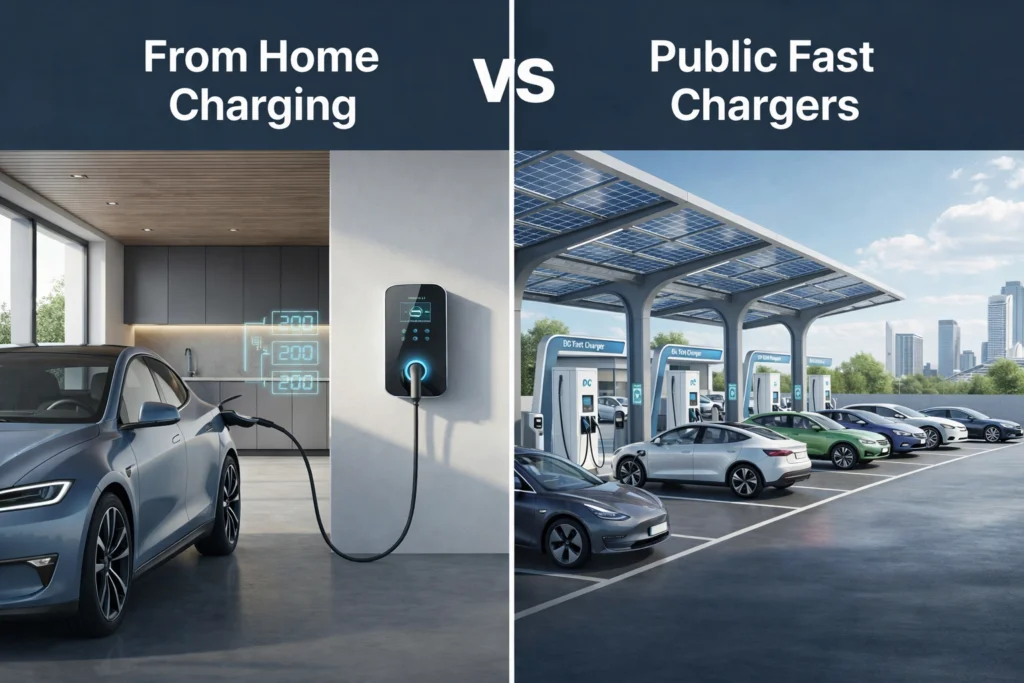
Most car shoppers don't give charging enough thought when they research an EV. They spend weeks comparing range, performance, and screens, then about 20 minutes on how they'll actually charge the thing. That lopsided attention has a cost. People who don't plan their charging end up putting up with slow Level 1 charging every day, or paying three to four times more per mile than they need to by leaning on public fast chargers. Neither has to happen. Once you understand how each charging option works and what it really costs, picking the right mix for your situation is easy.
Below, we go through every charging level with real numbers, then help you work out which combination makes sense for you.
The Three Levels of EV Charging
EV charging is split into three levels based on how much power goes into the car. They aren't marketing labels. Each one uses a different electrical setup, needs different installation, charges at a different speed, and suits a different situation.
Level 1 uses a standard 120V household outlet, the kind you plug a lamp or phone charger into. Level 2 uses 240V, the same as an electric dryer, oven, or water heater. DC fast charging skips the car's onboard charger entirely and feeds DC power straight into the battery at much higher power than any AC charger can.
Level 1: The Included Cable
Most EVs sold in North America come with, or offer, a portable charging cable that plugs into a standard 120V outlet. There's nothing to install. If there's an ordinary outlet near where you park, you can start charging right away.
Level 1 is slow, adding about 3 to 5 miles of range per hour depending on the car and the circuit. At 4 miles an hour, eight hours overnight adds about 32 miles. If you drive 25 to 30 miles a day, charging on Level 1 every night technically keeps up, and you'll leave with a full battery each morning as long as you never skip a night.
Where Level 1 falls apart is when anything goes off script: a night you forget to plug in, a day with more driving than usual, or cold weather, which both uses more energy and slows charging a little. You also have to keep making sure you never use more range in a day than one night can put back. And it ties up an outlet for hours at a time, which is a nuisance if that outlet has other jobs in your garage.
Our take: Level 1 is fine as a backup, for people who rarely drive, or for very short daily trips. As the main way to charge a daily driver, it keeps you constantly managing your battery, a hassle Level 2 removes completely. The $600 to $1,400 it typically costs to install Level 2 is the most worthwhile money an EV owner can spend, and you should count it as part of the price of the car.
Level 2: The Daily Driver's Solution
Level 2 charging runs on 240V from a dedicated circuit and adds about 15 to 35 miles of range per hour, depending on the car's onboard charger (the part inside the car that turns AC power into DC for the battery). Most current EVs accept 7.2 kW to 11.5 kW on Level 2, which works out to roughly 22 to 35 miles per hour.
For most EVs with 250 or more miles of range, one night on Level 2 takes the battery from 20% to full by morning, whatever time you plug in. That changes the whole experience. You stop thinking about charging, plug in when you park, and unplug when you leave. It takes longer than filling a gas tank, but none of that time needs you there. You're asleep or inside.
Level 2 needs either a hardwired charger, officially called EVSE (Electric Vehicle Supply Equipment), or a 240V outlet, usually a NEMA 14-50 like the ones used for RVs and some electric ranges. The charger costs $200 to $700. Installation labor runs $200 to $700 if your electrical panel has room, or $1,500 to $4,000 more if it needs upgrading. In a straightforward home, expect $600 to $1,400 all in.
| Charging Level | Voltage | Power | Miles/Hour | Full Charge (75 kWh) | Setup Cost |
|---|---|---|---|---|---|
| Level 1 | 120V | 1.2 kW | 3–5 mi | 60–70 hrs | $0 (included) |
| Level 2 (32A) | 240V | 7.7 kW | 22–25 mi | 9–11 hrs | $600–$1,400 |
| Level 2 (48A) | 240V | 11.5 kW | 30–35 mi | 7–8 hrs | $800–$1,600 |
| DC Fast (100 kW) | DC direct | 100 kW | ~250–350 mi (peak) | 45–60 min (10–80%) | $0 (public) |
| DC Fast (250 kW) | DC direct | 250 kW | ~500+ mi (peak) | 20–30 min (10–80%) | $0 (public) |
DC fast charging speeds are peak rates. Charging slows as the battery fills, so fast charging times are shown for 10% to 80%, the range most drivers use on road trips.
DC Fast Charging: Understanding the Premium Option
DC fast charging (DCFC) delivers far more power than AC charging by bypassing the car's onboard charger. The station itself converts grid AC power to DC and sends it straight to the battery through the car's fast-charge port. You need a car that supports it, which almost every modern EV does, and a compatible station.
Station power varies a lot. Older CHAdeMO and early CCS chargers may only put out 50 kW. Many newer stations from Electrify America, EVgo, and ChargePoint offer 150 to 350 kW. Tesla's V3 and V4 Superchargers deliver up to 250 kW or more, and IONNA's high-power sites typically offer up to around 400 kW.
How fast your car actually charges depends on whichever is lower: what the station can deliver or what your car can accept. An 800-volt car like the Hyundai IONIQ 5 or IONIQ 6 can take very high power, often more than many stations can supply. A car that tops out at 150 kW, like the Chevrolet Equinox EV, won't charge any faster at a 350 kW station. In the real world, cars usually hit their highest speed only briefly, and battery temperature and charge level keep them below peak most of the time.
Charge level affects speed too. Fast charging is quickest at low battery levels, roughly 10 to 50%, and slows as the battery fills. Most automakers suggest stopping around 80% on fast chargers, both because charging slows sharply above that and because frequently fast charging to a very high level puts a bit more stress on the battery. On road trips, several shorter stops charging to about 80% usually get you there faster than fewer long stops charging to 100%.
Home Charging Costs: What You Pay Per Mile
What home charging costs depends on your electricity rate and your car's efficiency. The math is simple: divide your cost per kWh by your car's miles per kWh to get cost per mile.
The national average residential electricity rate in 2026 is around $0.16 per kWh. A Tesla Model Y gets roughly 3.5 miles per kWh. That's $0.16 ÷ 3.5 = about $0.046 per mile, or $6.86 for 150 miles, about what two gallons of gas would cost.
With a time-of-use (TOU) rate, which many utilities offer for overnight charging, electricity can drop to $0.08 to $0.12 per kWh. At $0.08, cost per mile falls to about $0.023, or $3.43 for 150 miles. That's the cheapest way to run an EV and one of the strongest financial reasons to make home charging your main source.
Over a year, a typical driver covering 15,000 miles in a Model Y uses about 4,286 kWh. At $0.16 per kWh, that's about $685 a year. At $0.08 on a TOU plan, it's about $343. A gas car getting 28 mpg at $3.50 a gallon would spend about $1,875 for the same 15,000 miles.
Public Charging Costs: Why Home Charging Is Not Optional
Public Level 2 charging is often free at hotels, shopping centers, and workplaces, or costs a few dollars a session, or roughly $0.20 to $0.40 per kWh at paid stations. For topping up while you run errands, it's cheap and handy.
Public DC fast charging is where the cost gap gets serious. Prices vary by network, location, time of day, and whether you pay for a membership, but in 2026 you'll commonly pay somewhere around $0.40 to $0.65 per kWh. Electrify America and EVgo sit in that range, with lower rates for members who pay a monthly fee. Tesla Superchargers usually charge Tesla owners less than owners of other brands, though non-Tesla drivers can often buy a membership to lower their rate.
At $0.48 per kWh, the Model Y costs about $0.137 per mile, or $20.57 for 150 miles. At $0.40, it's about $0.114 per mile, or $17.14 for 150 miles. Compare that with $6.86 for the same 150 miles charging at home at $0.16. That's $10 to $14 more per 150 miles, or roughly $1,000 to $1,400 more a year if you did all 15,000 miles on public fast chargers instead of at home. The gap is huge, and it doesn't go away.
That's why home charging is so important to the EV's cost advantage over gas. An EV owner who does most of their charging at public fast chargers can pay more per mile than someone driving a 35 mpg gas car at $3.50 a gallon: about $0.10 a mile for the gas car against $0.11 to $0.14 a mile for public fast charging.
Public Charging Networks in 2026: Who's Best
Public charging in 2026 is better than it was a few years ago, but quality, reliability, and coverage are still uneven. Here's where the major networks stand:
Tesla Supercharger: the benchmark for reliability, with excellent uptime and seamless navigation for Tesla owners. Much of the network is now open to other brands, either through native NACS ports or approved adapters, at prices competitive with other networks. Coverage along major US interstates is excellent. Rural coverage is thinner than gas stations but has grown a lot in recent years.
Electrify America: one of the biggest high-power networks, with 150 to 350 kW chargers at most sites. Its reliability has improved noticeably from its rough early years, though it still trails Tesla. The app and payment work but aren't seamless. Stations cluster along highways and at shopping centers in major metro areas, with less coverage in smaller cities and rural areas.
IONNA: a joint venture backed by BMW, GM, Honda, Hyundai, Kia, Mercedes-Benz, Stellantis, and Toyota, opening stations since 2025. Sites offer high-power charging with both NACS and CCS connectors, plus amenities like covered bays and restrooms, aiming for a Supercharger-like experience. It's growing quickly but is still smaller than the established networks.
ChargePoint: the largest Level 2 network, with a meaningful number of fast chargers too. It mainly serves workplaces, apartment buildings, and shopping destinations. It's very handy for charging where you're already going, but less focused on highway travel than Electrify America or IONNA.
Reliability: The Data That Matters for Real Trips
How reliable a network is, meaning how often you pull up and actually get a working charge, varies a lot and affects road trips more than any spec. A 350 kW charger that's broken one visit in five is worse than a 150 kW charger that works every time if you need to charge on a schedule.
Driver reports on PlugShare, reliability studies, and surveys by automotive journalists keep pointing the same way. Tesla's Superchargers are the most dependable. Newer networks like IONNA have started out well. Electrify America, EVgo, and ChargePoint's fast chargers have improved but still see more broken or derated stalls. That gap is real and matters when you plan a road trip. If you're taking a long trip in a non-Tesla EV, or using third-party networks, always have a backup plan: know where the next station is and make sure you have enough charge to get there.
Home Charger Installation: The Practical Steps
Almost everywhere in the US, installing a home Level 2 charger calls for a licensed electrician, both for permits and for safety. The process usually goes like this:
- The electrician checks whether your panel has room for a new 50 or 60-amp circuit.
- They pull a permit, which most towns require. It typically costs $50 to $150 and is routine for a licensed electrician.
- They run the new circuit from the panel to where you park.
- They install either a 240V outlet or a hardwired connection for the charger.
- Your local building department inspects the work.
Get quotes from a few licensed electricians. Prices often vary by $200 to $400 between contractors, and the work is similar among licensed pros. Ask directly: "Will I need a panel upgrade, and what would that cost?" That one question can save you from a surprise that doubles your budget.
The federal home charger tax credit, which covered 30% of costs up to $1,000, ended for chargers installed after June 30, 2026, so most people installing now won't get it. Many utilities still offer rebates for Level 2 installations, often a few hundred dollars, and some states and cities have their own programs. Check what's available before you buy equipment, since some rebates only cover certain charger models.
No Home Charging: The Honest Assessment
If you can't charge at home, because you rent an apartment, live in a condo without assigned parking, or rent a house without a garage, owning an EV works very differently. Public charging becomes your main source, which means higher costs per mile and more planning for everyday charging.
A few strategies help, though none fully solves it. Workplace charging, if your employer offers it, is often free or cheap Level 2 that can stand in for home charging. Destination charging at places you visit regularly, like the gym, grocery store, or library, can also help, and many offer free Level 2. Or you can use the EV mainly for shorter trips and top up at public chargers on bigger days.
Several states have passed right-to-charge laws that require landlords or HOAs to allow EV charger installations in many cases, and many apartment buildings built in recent years include Level 2 charging. Things are improving, but for many city renters it's still a real obstacle. If you rent and are thinking about an EV, ask building management about charging, check your state's right-to-charge rules, and be honest with yourself about whether the charging setup will really work for how you drive before you buy.
Time-of-Use Rates: How to Cut Charging Costs by 50%
Many US utilities offer time-of-use (TOU) plans that charge different prices at different times of day. Peak hours, often around 4 p.m. to 9 p.m. on weekdays, can cost $0.35 to $0.45 per kWh in some areas. Off-peak hours, often overnight, can drop to $0.06 to $0.12 per kWh, 50 to 75% cheaper than peak.
If you set your charging to happen off-peak, which is easy with a smart Level 2 charger's scheduling feature or your car's own app, a TOU plan can cut your home charging costs roughly in half. Using the earlier numbers, 15,000 miles a year in a Model Y costs about $685 at a flat $0.16 per kWh and about $343 at an off-peak rate of $0.08. That's about $342 saved each year, year after year.
Call your utility and ask: "Do you have a time-of-use or EV rate plan?" Some utilities have EV-specific plans with even lower overnight rates than their standard TOU plans, designed to move charging to times when the grid has spare capacity. Before switching, compare the plan against your whole household's usage, since some TOU plans raise costs for other things you do during peak hours.
The Verdict by Driver Type
Home charging for everyday use, plus public fast charging for road trips, is the right setup for most EV owners. It gives you the lowest cost per mile, no range planning in daily life, and public networks for the small share of driving that needs them.
Workplace charging as your main source, with occasional public charging, works well if your employer offers free or cheap Level 2 charging and your car sits plugged in long enough during the day. Whether it works depends on how long you're plugged in and how many miles you need to put back.
Public charging only makes sense for very low-mileage drivers, averaging under about 30 miles a day, in areas with lots of reliable public Level 2 chargers, or as a stopgap while you arrange home charging. For typical American driving, the cost and planning make it hard to sustain as your main way to charge.
The calculation every apartment dweller needs to do
Before buying an EV you can't charge at home, run the numbers honestly. If you'd mostly use public fast chargers at around $0.45 per kWh, what would you spend on charging in a year, and how does that compare with what you spend on gas now? For many drivers in this spot, charging would cost more than gas. The EV would still save on maintenance and have other advantages, but the fuel savings, the most common money argument for EVs, may not apply to you until home or workplace charging is an option.