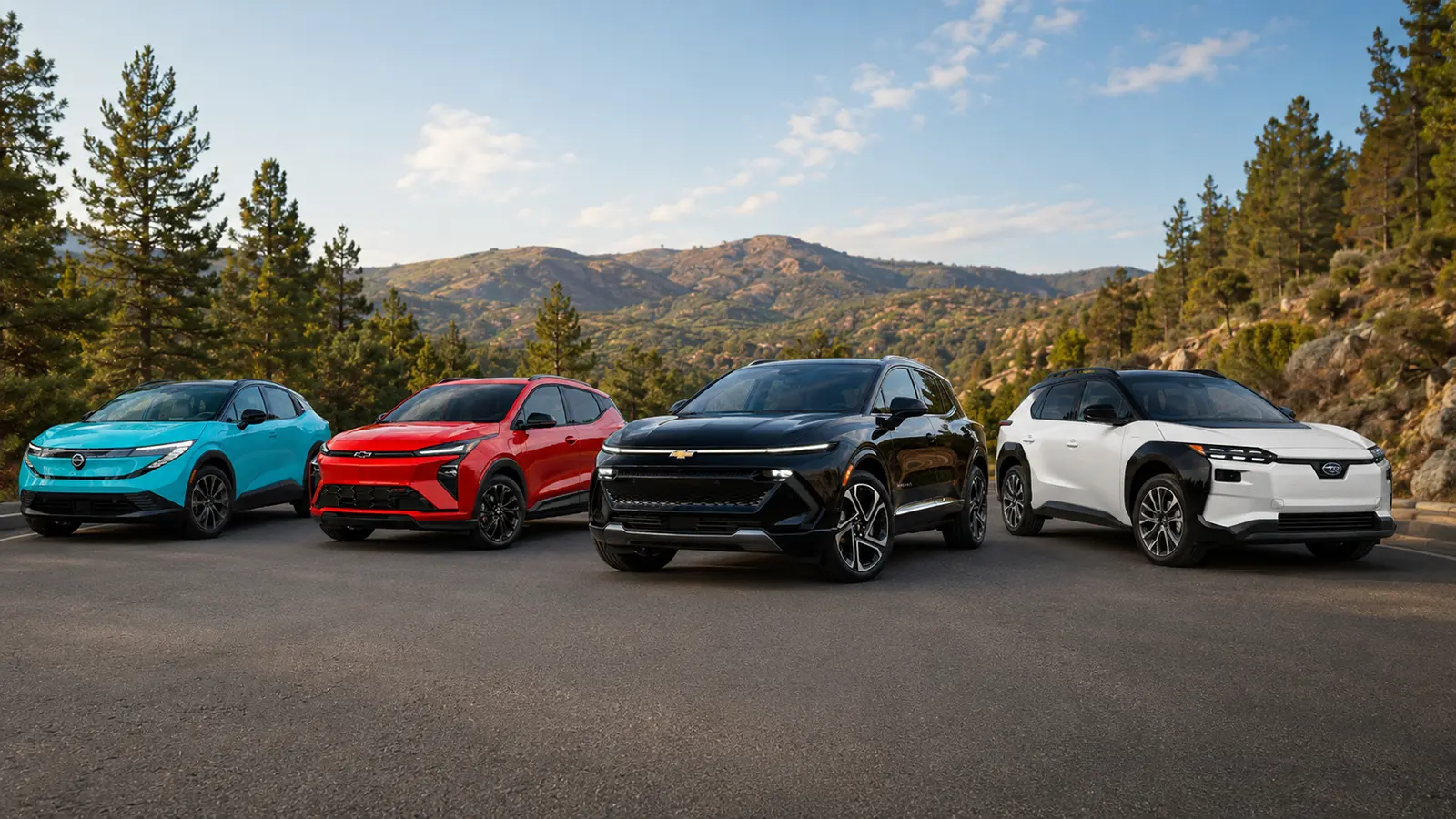
As recently as 2024, there wasn't much to choose from among EVs under $40,000, and the ones you could buy came with real compromises. That's changed. The federal $7,500 EV tax credit ended on September 30, 2025, and several automakers answered by cutting prices or launching cheaper models. The result is that in 2026 you can buy a good EV with 250 to 320 miles of range for well under $40,000, before any incentives.
A note on how we picked. "Under $40,000" means you can buy a usable version of the car for less than that at a dealer or online, not a stripped-out base model or a price that only exists in a press release. These are real cars you can configure and drive home.
The Top 5 Electric Cars Under $40,000 in 2026
1. Chevrolet Equinox EV: $34,995
The Equinox EV is still one of the best-value EVs in America. For $34,995, the base 1LT front-wheel-drive model gives you 319 miles of EPA-rated range, a roomy compact SUV body, fast 11.5 kW home charging, and a comfortable, quiet ride. DC fast charging tops out at 150 kW, slower than Tesla or Hyundai but fine for most road trip stops. The 2026 model still has a CCS charge port, so you'll need GM's approved adapter to use Tesla Superchargers. The big catch is that there's no Apple CarPlay or Android Auto. GM uses a Google-based system instead, and for some iPhone users that alone rules it out.
2. Tesla Model 3 Standard: about $37,000
Tesla's new Model 3 Standard is the cheapest way into a Tesla sedan, starting at roughly $36,990 before destination and fees (about $38,630 delivered). It trims some features, like the rear touchscreen and some interior materials, but keeps what counts: an EPA-rated 321 miles of range on 18-inch wheels, excellent efficiency, and native access to the Supercharger network, which is still the most reliable fast charging network in North America. Tesla's over-the-air updates keep improving the car over time. Like the Equinox EV, it has no Apple CarPlay or Android Auto, and the minimalist cabin, with nearly everything run through the center screen, isn't for everyone.
3. Hyundai IONIQ 5 Standard Range: $35,000
Hyundai cut 2026 IONIQ 5 prices by up to $9,800, and the base RWD Standard Range model now starts at $35,000. That's a lot of car for the money. The Standard Range gets about 245 miles of EPA range, which is the shortest here except for the Bolt, but it makes up for it with Hyundai's 800-volt charging system. At a fast enough charger, it can go from 10% to 80% in well under half an hour, among the quickest in this price range. It has a native NACS port for Supercharger access, a flat floor with a roomy, flexible cabin, and Apple CarPlay and Android Auto. If you want the most modern-feeling EV in this group, this is it.
4. Nissan Leaf (2026): $29,990
Forget the old Leaf. The 2026 model is all new, a sleek small crossover that starts at $29,990 for the S+ trim and delivers up to 303 miles of EPA range. It fixes the old Leaf's biggest problems. The outdated CHAdeMO plug is gone, replaced by a NACS fast charging port that works at Tesla Superchargers, plus a J1772 port for Level 2 charging. The battery also has proper liquid cooling now. Higher trims add features but lose some range: the SV+ is rated at 288 miles and the Platinum+ at 259. For the money, the base S+ is one of the best range-per-dollar deals on the market.
5. Chevrolet Bolt (2027): $28,995
The Bolt is back. The 2027 Bolt LT starts at $28,995 and has an EPA-estimated 262 miles of range. It's Chevy's first car with a built-in NACS port, and its DC fast charging peaks at 150 kW, more than two and a half times as fast as the old Bolt. It's a small hatchback, so it won't carry as much as the Equinox EV, but for commuters and city drivers who charge at home, it's the cheapest way into a new EV with a useful range. Chevy says it's a limited run, so availability may be tight in some areas. Like other new Chevy EVs, it uses Google built-in instead of CarPlay and Android Auto, so check that before you buy.
What Happened to the Federal Tax Credit
For several years, the $7,500 federal tax credit made many EVs much cheaper than their sticker price. The One Big Beautiful Bill Act ended it for vehicles acquired after September 30, 2025, along with the $4,000 used EV credit. There's a narrow exception for buyers who signed a binding purchase contract and made a payment before that date. Almost everyone shopping in 2026 won't get any federal credit at all.
That's why the prices in this article are straight MSRPs with nothing taken off. Some states and utilities still offer their own EV rebates, so check what's available where you live, and shop around for dealer discounts and low-rate financing, which several brands have used to make up for the lost credit. You can compare the range and efficiency of the models below at fueleconomy.gov.
| Vehicle | Starting Price | EPA Range | Max DC Charge | Charge Port |
|---|---|---|---|---|
| Chevy Equinox EV 1LT | $34,995 | 319 mi | 150 kW | CCS1 (NACS adapter) |
| Tesla Model 3 Standard | ~$36,990 | 321 mi | Supercharger | NACS |
| Hyundai IONIQ 5 SR RWD | $35,000 | ~245 mi | 800V fast charging | NACS |
| Nissan Leaf S+ | $29,990 | 303 mi | Fast charging via NACS | NACS + J1772 |
| Chevy Bolt LT | $28,995 | 262 mi | 150 kW | NACS |
Prices are MSRP before destination fees and can change. Confirm current pricing with the manufacturer or dealer before you buy.
My Recommendation
For most buyers under $40,000, the Chevrolet Equinox EV is still the best all-around package, as long as you can live without CarPlay. You get 319 miles of range, an SUV body with real cargo space, and fast home charging, all for about $35,000. If CarPlay is a must and you want quick road trip charging, the Hyundai IONIQ 5 is the better choice for about the same money, though you give up some range. And if you want to spend as little as possible, the new Nissan Leaf and Chevy Bolt deliver more range for under $30,000 than any EV could a couple of years ago.
One caveat: the EV market is moving fast. Prices shift, new models arrive, and today's list may need updating within months, so double-check current pricing before you decide.
Complete Ownership Cost Comparison Over 5 Years
The sticker price is only the start. To compare what each car really costs, you have to add electricity, insurance, and maintenance, then subtract what the car is likely to be worth when you sell. For the estimates below, we assumed 15,000 miles a year, all home charging at $0.16 per kWh, and a five-year ownership period. Treat them as rough guides, since insurance and resale values vary a lot by location, driver, and market conditions.
The Equinox EV uses about 3.5 miles per kWh, which works out to roughly $685 a year in electricity, or about $3,425 over five years. Insurance typically runs around $1,600 to $2,000 a year. That's more than a similar gas SUV, mainly because EV repairs cost more. Maintenance is light, since there are no oil changes and regenerative braking reduces brake wear, so expect mostly tires, wipers, and cabin filters. Resale is the biggest unknown. Used EV values have been volatile, and the loss of the federal credit has reshuffled pricing. We've assumed it keeps a bit under half its value after five years.
The Model 3 Standard is more efficient, at about 4.2 miles per kWh, so it costs less to charge, roughly $2,860 over five years. Insurance is usually higher for Teslas because of repair costs. What helps the Model 3 is resale. Strong demand for used Teslas and access to the Supercharger network tend to keep values higher than most non-Tesla EVs.
The IONIQ 5, Leaf, and Bolt start from lower or similar prices. The Leaf and Bolt in particular have low purchase prices and reasonable insurance costs, which gives them a head start over five years even if they lose a similar share of their value.
| Vehicle | 5-Yr Electricity | 5-Yr Insurance (est.) | 5-Yr Maint | Resid. Value (est.) | Net 5-Yr Cost (est.) |
|---|---|---|---|---|---|
| Chevy Equinox EV 1LT | $3,425 | $9,000 | $750 | ~$16,000 | ~$32,170 |
| Tesla Model 3 Standard | $2,860 | $11,500 | $700 | ~$20,000 | ~$32,050 |
| Hyundai IONIQ 5 SR | $3,640 | $9,500 | $750 | ~$16,000 | ~$32,890 |
| Nissan Leaf S+ | $3,330 | $8,000 | $700 | ~$13,000 | ~$29,020 |
| Chevy Bolt LT | $3,240 | $8,000 | $700 | ~$13,500 | ~$27,435 |
Net cost here means purchase price plus electricity, insurance, and maintenance, minus estimated resale value. By this rough measure, the Bolt and Leaf are the cheapest to own over five years, mostly because they cost so much less to buy. The Equinox EV, Model 3, and IONIQ 5 end up within about $1,000 of each other. The Model 3's stronger resale value makes up for its higher price and insurance, so the choice between those three is really about which car suits you best, not which is cheapest.
Charging Infrastructure: How Each Vehicle Fares on the Road
If you charge at home on Level 2, all five cars work well for daily driving. You wake up to a full or nearly full battery, and the differences in range and charging speed hardly matter. Charging only becomes a real point of difference on road trips and for the many drivers who can't charge at home.
Supercharger access has become far less of a Tesla-only advantage. The Model 3, IONIQ 5, Leaf, and Bolt all have NACS ports and can plug straight into many Superchargers, while the 2026 Equinox EV needs GM's approved adapter to do the same. Tesla's network is still known for high uptime and lots of stalls per site, so being able to use it makes road trips much less stressful. The Tesla still has the smoothest experience, with charging stops planned automatically in the navigation and payment handled without any extra app.
The IONIQ 5's 800-volt system is the speed champion here when you find a charger that can keep up with it. But fast charging only helps if the station is working and free. On busy routes, it's smart to have a backup stop in mind, whatever you drive. Tesla Superchargers and the growing IONNA network have generally been the most dependable options.
If you live in a city without home charging, range and access to reliable public chargers matter more. The Equinox EV's 319 miles and the Leaf's 303 miles mean fewer charging stops, and NACS-equipped cars have more fast charging options nearby. The old Leaf's CHAdeMO plug, which fewer and fewer stations support, is no longer a concern with the new model.
Software, Updates, and Future-Proofing
EVs increasingly behave like software products that either get better over time or don't. Tesla's over-the-air updates are the most mature in the industry, refined over more than a decade. Owners regularly see improvements to energy management, range estimates, and driver assistance long after they buy. Over five years of ownership, that ongoing improvement has real value.
Hyundai's over-the-air updates on the IONIQ 5 have grown more capable and now cover more of the car's systems, though they come less often and change less than Tesla's. GM's newer EVs, including the Equinox EV and Bolt, receive over-the-air updates through the Google-based system, and GM's software has improved after a rocky start with its first EVs on the same platform. The new Leaf is Nissan's most connected EV yet, but Nissan's update track record is still being established.
If you plan to keep your EV for five to seven years, the software matters almost as much as the hardware. A car whose software stops improving after the first year starts to feel old even when the hardware is still competitive. Tesla has the strongest record here, Hyundai is improving, and GM and Nissan still have something to prove.
The Decision Framework
With all the specs, costs, and charging details laid out, choosing an EV under $40,000 in 2026 comes down to three questions.
First, can you charge at home on Level 2? If so, all five cars will handle daily driving easily, and you can focus on range, features, and cost. If not, prioritize range and easy access to reliable fast charging. The Model 3 and the NACS-equipped cars have the edge here.
Second, do you need Apple CarPlay or Android Auto? This one rules cars out quickly. The Equinox EV, Bolt, and Model 3 don't offer either. The IONIQ 5 and Leaf do. If you use CarPlay every day and would miss it, start your shortlist with those two.
Third, how often do you drive more than 200 miles from home? For a few road trips a year, any of these cars will do with some planning. If you road trip monthly or more, charging speed and network access matter most, which favors the Model 3 for its seamless Supercharger experience and the IONIQ 5 for its very fast charging.
The recommendation for most buyers in 2026
If you can charge at home and don't need CarPlay, the Chevrolet Equinox EV at $34,995 gives you the most range and space for the money. If you need CarPlay, the Hyundai IONIQ 5 at $35,000 is the pick. If road trips are a big part of your life, the Tesla Model 3 Standard offers the smoothest long-distance experience. And if you want the lowest price possible, the 2026 Nissan Leaf and 2027 Chevy Bolt both start under $30,000 with more than 260 miles of range.
The Technology Gap Between Budget and Premium EVs
These cars differ in more than their spec sheets. Tesla's standard Autopilot handles lane centering and traffic-aware cruise control on the highway, with the driver still watching the road and holding the wheel. It makes long highway drives much less tiring. GM's Super Cruise, available on the Equinox EV, goes further: it allows true hands-free driving on hundreds of thousands of miles of mapped highways in the US and Canada, while a camera makes sure you're watching the road. It works only on those mapped roads and needs a paid subscription after the included trial. For commuters who spend a lot of time on major highways, hands-free driving is a real quality-of-life upgrade. For mostly city and suburban driving, it adds much less.
Hyundai's Highway Driving Assist on the IONIQ 5 keeps the car centered and at a set speed but requires your hands on the wheel. That's typical for EVs in this price range. If hands-free highway driving specifically matters to you, the Equinox EV with Super Cruise is the main option under $40,000, as long as you're willing to pay for the option and the subscription.
Over-the-air updates also vary across this group. Tesla leads with the most frequent and far-reaching updates. Hyundai and GM both deliver updates that are becoming more meaningful. Nissan's system is newest with the latest Leaf. If you want a car that keeps improving through software, Tesla is the safest bet, with Hyundai and GM behind it.
Safety Ratings for All Five Vehicles
Safety is a strength across today's mainstream EVs, and all five of these cars come with a strong set of safety features. Some, though, are so new that crash testing results may still be limited. The Tesla Model 3 and Hyundai IONIQ 5 have both earned top IIHS awards in recent model years. The 2026 Nissan Leaf and 2027 Chevy Bolt are all-new designs, so their full IIHS and NHTSA results may not be available yet. Check the latest ratings for the exact model year and trim at iihs.org and nhtsa.gov before you buy.
Automatic emergency braking with pedestrian detection, lane departure warning, rear cross-traffic alert, and blind spot monitoring are standard or easy to get on every car here. If you care about specific safety tech, like how well automatic braking works or how sensitive the alerts are, look at IIHS's detailed test results for the model you're considering. These systems perform differently in standardized tests, and those differences don't show up in a simple pass or fail.