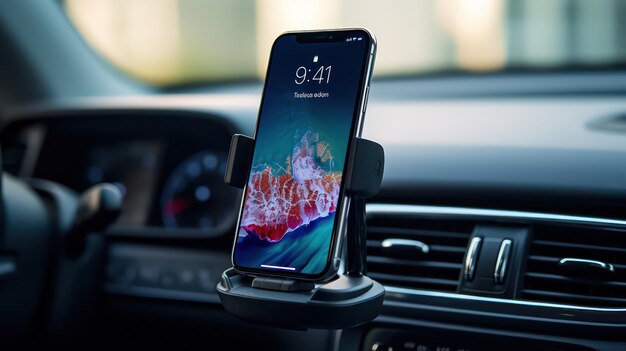
Cheap phone mounts fail more often than people think, and they don't usually fail slowly. A mount that's been working loose for weeks can let go without warning and send your phone into the footwell mid-drive. Magnetic vent clips under $15 are the worst for this. Heat and road vibration wear out both the clip tension and the adhesive, and by the time the mount feels wobbly, it's often about to give up completely.
Think of a phone mount as safety equipment. A phone sliding around the passenger seat or propped on the dash is a distraction. A phone dropping to the floor at highway speed is an emergency. A phone held firmly at the right height and angle, charging while it shows you directions, lets you keep your eyes up and your hands on the wheel. Saving $15 on the cheapest option isn't worth the extra risk.
Here's what held up in our testing, and what we think is worth buying.
The Four Types of Car Phone Mounts: A Practical Comparison
Before looking at specific products, it helps to understand how the main types of mount differ. Otherwise it's easy to buy a good mount of the wrong type for your car and habits.
Almost every phone mount fits one of four types: vent clips (which grip the air vent slats), dashboard adhesive mounts (which stick to the dash), windshield suction mounts (which attach to the glass), and cup holder mounts (which sit in a cup holder). Each one has its own trade-offs, and the best choice depends on your car's layout, how you use your phone, and what you care about most.
Vent Mounts: The Most Popular Choice, Done Well or Done Wrong
Vent clips are the best sellers because they're quick to fit, easy to take off, and put the phone close to eye level without changing anything in the car. The good ones, like the ESR HaloLock, Andobil, and Scosche MagicMount, work great every day. The bad ones, the $8 spring-clip no-name mounts that fill online search results, gradually shake loose, fall off at the first pothole, and create the very distraction you were trying to avoid.
Poor vent mounts usually fail the same way. The spring clip loses its grip as the plastic tires out from being clamped on and off the vent over and over. Better vent mounts use metal parts in the clip, a screw you tighten instead of just spring pressure, and an extra brace below the clip so the phone's weight isn't all hanging off one pivot.
One thing people often forget to check is which way their vent slats run. Horizontal slats, common in Japanese and American cars, and vertical slats, more common in European cars and some trucks, need different clip designs. Round vents, found in many Volkswagen, Audi, and Volvo models, don't work with most vent clips at all, so you'll need a dashboard or windshield mount instead. Look at your vents before you buy.
Vent mounts also have a temperature issue. If the phone sits right in the airflow, hot or cold air blowing on it can slow charging and, over time, wear the battery. Mounting it on a side vent instead of a center vent, or angling it out of the direct blast, helps. The ESR HaloLock goes further with a built-in cooling fan that fights heat buildup while it charges.
Dashboard Mounts: Maximum Stability at the Cost of Commitment
Dashboard adhesive mounts are the sturdiest type because they're stuck to the biggest, most solid surface in the cabin, not a thin plastic vent slat or slick glass. A well-installed 3M adhesive dash mount doesn't shake, rattle, come loose in the heat, or get knocked off by a pothole. Once it's on, it stays on.
The catch is that you're committing to that spot. Heavy-duty 3M adhesive is designed to be permanent. Getting it off cleanly takes gentle heat and patient work with a plastic pry tool so you don't damage the dash. For most people that's fine for a mount they'll use every day for years. If you change cars often, or want to move the mount into rentals, adhesive isn't practical.
Because you can't easily move it, think carefully about where a dashboard mount goes. For most drivers, the sweet spot is near the base of the windshield, just off to the side of the steering wheel, where you can glance at the screen without turning your head much and it doesn't block your view of the road. Before you peel the backing, hold your phone in that spot for a drive to make sure it works for you.
Windshield Mounts: Flexibility with Important Legal Caveats
Windshield suction mounts give you more freedom of placement than dash or vent mounts. You can put the phone almost anywhere on the glass, which makes it easy to get the height right whatever your size or seating position. Good suction cups hold well on clean, smooth glass. They're much less reliable on textured or coated glass, or glass with cleaner residue on it.
The legal side is important. Many states have rules against anything that blocks the driver's view through the windshield, and the details vary. California, for example, doesn't ban windshield phone mounts outright but only allows them in certain spots: a 7-inch square in the lower corner on the passenger side, or a 5-inch square in the lower corner on the driver's side, outside any airbag deployment area. Other states are stricter or vaguer. Check your own state's current rules before buying a windshield mount, since these laws have been changing as phones have become standard navigation tools.
Where windshield mounting is clearly allowed, a good suction mount such as the Kenu Airframe+, iOttie's suction models, or RAM Mounts is a solid choice. If your state's rules are strict or unclear, stick with a vent or dashboard mount.
Cup Holder Mounts: For When Nothing Else Works
Cup holder mounts are for cars where nothing else works: vents a clip won't grip, a textured or curved dash that adhesive won't stick to, and windshield rules that rule out suction. They aren't ideal for viewing, since the phone sits well below eye level, near the center console, but they're stable and secure when you've run out of other options.
Their big advantage is that they don't change anything. There's no adhesive, no clip, and nothing touching the glass. You give up a cup holder, which can hurt in some cars, and get a steady mount in return, even if it's low. For older trucks with few mounting spots, or cars with round vents and textured dashboards, they're often the right answer despite the lower viewing angle.
1. ESR HaloLock Wireless Charging Vent Mount: Best Overall (~$45)
The ESR HaloLock has stayed at the top of our list because it's the only vent mount at this price that fixes all three big vent mount problems at once. It holds tight thanks to strong N52 neodymium magnets for a MagSafe-style connection. It deals with heat using a cooling fan built in behind the charging pad. And it stays put with a clip you tighten with a screw instead of a spring.
The fan is what takes it from good to great. Wireless charging heats up your phone, and heat while charging wears down the battery over time. The ESR's fan is quiet enough that you'll barely hear it over normal road noise, and it keeps the back of the phone cool enough that the phone doesn't need to slow its charging. When we compared it side by side with a similar mount without a fan in a warm car, the ESR kept charging at full speed while the other mount's charging slowed down after about 15 minutes.
It's built for MagSafe iPhones (iPhone 12 and later), and Android phones that support Qi2 also get fast magnetic charging. Phones without MagSafe or Qi2 can use the included stick-on magnetic ring, but they'll charge at slower standard Qi speeds.
Installing it on a Toyota Camry with horizontal vents took about 8 minutes. You tighten the clip with a coin, which is a little fiddly but far more secure than any spring clip we tried. It connects over USB-C, and you'll need a 12V USB adapter for the car's power socket; ESR sells a 30W adapter for about $18. Even with the adapter and cable, the whole setup comes to around $70 to $75, and we still think it's the best-value wireless charging mount out there.
2. iOttie Easy One Touch 6: Best Mechanical Clamp (~$30)
The iOttie Easy One Touch 6 is the one to get if you don't want magnets. Maybe your phone doesn't support MagSafe, your case is too thick for a magnetic mount, or you just trust a physical grip more. You push the phone into the cradle and the arms close around it automatically. After six generations, iOttie has made that mechanism smooth and easy to use with one hand.
An adjustable arm lets you bring the phone closer to you or push it further toward the windshield, and a ball joint at the head lets you rotate and tilt it to the angle you want. Clips along the arm keep the charging cable tidy so it isn't dangling across the cabin.
The suction base works on the windshield or the dashboard, so it's more flexible than a vent-only mount. It grips well on smooth dashboards, and for textured ones iOttie includes an adhesive disc that gives the suction cup a smooth surface to hold. In our back-to-back driving, it was as steady as the ESR HaloLock on smooth roads and a little steadier on rough ones, because a mechanical grip doesn't care if the phone shifts slightly off its magnets over bumps.
3. Scosche MagicMount Pro2: Best for Maximum Flexibility (~$35)
The Scosche MagicMount Pro2's big selling point is flexibility. It comes with a range of mounting options for the same magnetic head, so you can set it up on a vent, stick it to the dashboard, or mount it higher on an arm, depending on the version you buy. One mount, several possible positions.
If you've tried a few spots and still haven't found the right one, or you switch between cars with different layouts, that flexibility is really useful. The magnetic head lines up nicely with MagSafe iPhones, but the basic Pro2 only holds the phone and doesn't charge it wirelessly. Scosche's charging versions add wireless charging for more money, which is still reasonable given how adaptable the system is.
The adhesive options use 3M VHB tape, the same industrial-strength tape that needs heat to remove cleanly. So choose the spot carefully, because you won't want to move it casually later. Take your time with the install: clean the surface with isopropyl alcohol, let the adhesive bond for 24 hours before hanging a phone on it, and get the position right the first time instead of counting on adjusting it afterward.
4. Belkin BoostCharge Pro Wireless Car Charger: Best for iPhone Users (~$60)
Belkin's BoostCharge Pro car mount is officially certified for MagSafe, not just "MagSafe-compatible." That means Apple has tested it and confirmed it charges the way it should, beyond simply using magnets to line things up. For you, that means extra confidence that it'll hit full MagSafe charging speed and line up correctly with your iPhone's charging coil every time.
The vent mount looks clean and minimal, with Belkin's usual premium finish. The cable comes out of the bottom, so it runs naturally down to the center console without awkward bends. The magnets are strong, too. In our driving, including some nasty potholes, the phone never budged.
It usually costs more than the ESR HaloLock for similar wireless charging performance. What you're paying for is the official certification and Belkin's quality control, along with a two-year warranty and responsive customer service, which is appealing if you want to buy something once and never think about it again. If you'd rather have the best value for money, the ESR HaloLock performs about as well for less.
5. MagBak Wireless Car Charger: Best Permanent Dashboard Mount (~$69)
The MagBak takes a different approach to dashboard mounting. Instead of a suction cup or a lever, it sticks straight to the dash with permanent 3M adhesive, so it's not coming off unless you remove it on purpose with some heat. The result is rock solid, with no movement, no shaking, and no rattling. The trade-off is that it really is permanent.
To fit it, clean the dash well with isopropyl alcohol and the included prep wipe, peel off the backing, press the mount into place, and wait 24 hours for the adhesive to cure fully. Once it's set, strong N52 magnets hold a MagSafe iPhone in place while it charges wirelessly, and an aluminum body with a small built-in fan helps keep heat down. It's compact and low-profile, so it doesn't clutter the dash the way bigger mounts do.
It's the mount we'd pick for someone who plans to keep their car for three years or more and wants the steadiest, most low-profile wireless charging setup available. For that job, the mix of rock-solid stability, small footprint, and MagSafe charging is hard to beat. If you want flexibility, though, it's the wrong mount. If you've found the perfect spot and want your phone there for good, it's the best choice.
6. Andobil Car Phone Holder: Best Budget Under $25 (~$20)
The Andobil one-touch vent mount is the right pick if you need a decent mount right now and only have $20 to $25 to spend. It isn't the best at any one thing, but it does all the important things well enough. The grip is firm, it fits phones from about 4 to 7.2 inches wide (so pretty much any current phone), the clip doesn't rattle on decent roads, and the ball joint gives you enough angle adjustment for most cars.
Compared with the ESR HaloLock, you give up wireless charging, and the lighter clip will probably wear out sooner than ESR's screw-tightened design. If you charge with a cable anyway and don't care about wireless, the Andobil does the job for a price you won't have to think twice about. If you want wireless charging or something that'll last for years, spend the extra $25 on the ESR.
7. Peak Design Car Mount: Best Premium Magnetic System (~$80)
The Peak Design car mount makes the most sense if you're already using Peak Design gear, like their phone cases plus their mounts for your bike, backpack, or tripod. Their SlimLink system combines magnets with a physical locking design, so the phone stays attached in situations where a plain magnetic mount might let go, and it still works with MagSafe alignment.
The mount itself feels premium, with an aluminum body, smooth adjustment at the head, and a neat vent clip that doesn't look like a cheap add-on. Because it uses the SlimLink standard, the same case clicks onto Peak Design's bike mount, backpack strap mount, and car mount in about a second, with no adapters. If you use several Peak Design mounts, the system is great value. If all you need is a car mount, $80 is a lot when the $45 ESR does the job.
MagSafe vs Universal Magnetic: The Choice That Matters Most
MagSafe mounts use Apple's specific magnet layout, which lines up the iPhone's charging coil exactly with the coil in the mount. That precise alignment is what allows full-speed MagSafe charging. Even slight misalignment drops the speed a lot. Universal magnetic mounts use different magnets that hold the phone but don't line it up precisely, so they're fine for holding a phone but won't give you full MagSafe charging speed.
If you have an iPhone 12 or newer and want to charge wirelessly in the car, go with a MagSafe-certified or MagSafe-compatible mount. Certified models give you the most certainty about charging speed. A MagSafe mount with strong N52 magnets holds tight enough for normal driving. On the Android side, Qi2 is the equivalent of MagSafe, with the same magnetic alignment. Check that your phone supports Qi2 before buying a Qi2 mount. Many recent Android flagships do, but plenty of midrange and budget phones don't.
Legal Considerations by State
Phone mount laws are more complicated than most people expect, and they vary from state to state. The real question usually isn't whether you can use a phone mount at all, but whether you can put it on the windshield. Windshield mounts are where the legal gray areas are. Many states ban objects that block the driver's view through the windshield, and some, like California, spell out exactly where a device is allowed (in California, small zones in the lower corners of the glass). Enforcement varies a lot. Dashboard and vent mounts sidestep most of these issues. If you're not sure, choose a dashboard or vent mount, and remember that most states with hands-free laws also require the phone to be mounted, not held.
The Home Stability Test That Predicts Real-World Performance
Before you rely on a new mount on the road, try this in the driveway. With your phone mounted, brace the dash or windshield with one hand and give the mount a firm tap with the other to mimic a hard pothole. Do it three times from different directions. A good mount will hold the phone without any movement or sound of loosening. A bad one will slip, rattle, or visibly loosen at the clip or adhesive. It takes 30 seconds, costs nothing, and gives you a very good idea of whether you can trust the mount once you're on the road.