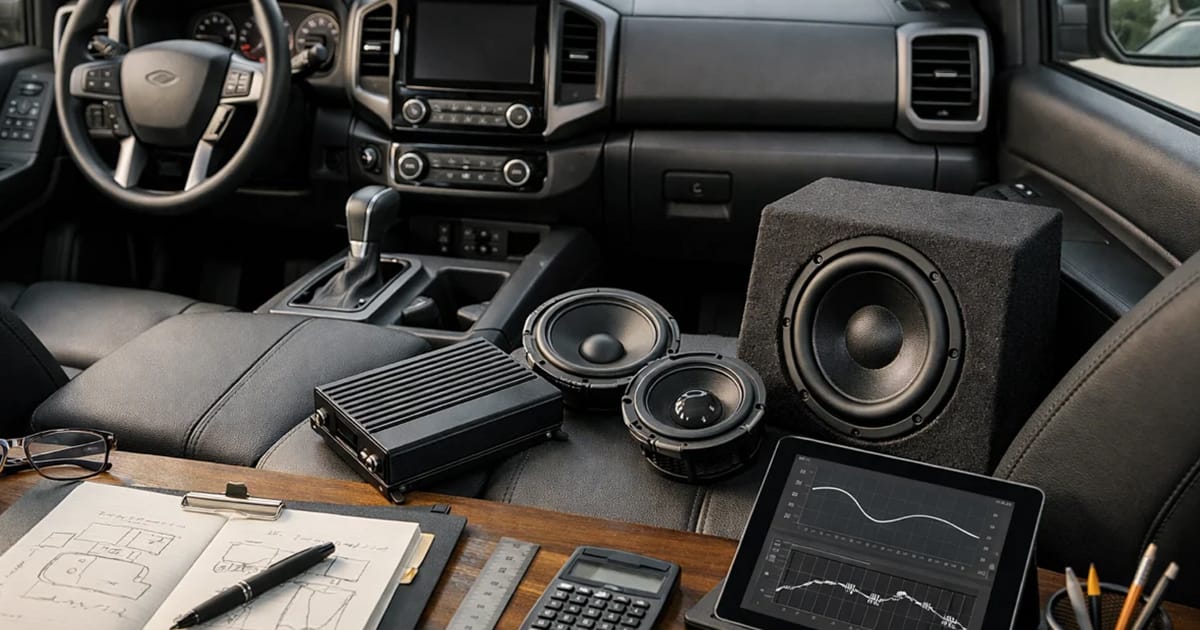
Even a modest aftermarket system, set up properly, shows you right away how much better your car could sound. New speakers, a head unit with a better DAC, and a small powered subwoofer can come in around $550 installed, and the change from stock is hard to miss. It's like going from hearing a band down the street to having them play in your living room.
Factory car audio is built to hit a price, not a sound quality target. On most mainstream cars, each speaker costs the automaker only a few dollars. They tend to use paper or cheap polypropylene cones, foam surrounds that break down after 3 to 5 years of summer heat, and magnets too small to move the air real bass needs. The head units are built cheaply too. Their DACs (digital-to-analog converters) add audible distortion as you turn it up, and their built-in amps run out of clean power at volumes a decent system would barely notice.
The good news is you don't need a pricey pro install or audiophile gear to beat factory sound. The upgrades that make the biggest difference follow a clear order, each one is a noticeable step up, and you can stop after any of them. Here's how to go about it.
The Right Strategy: Upgrade in the Right Order
The order you upgrade in counts almost as much as what you buy. A lot of people add a subwoofer first, because more bass is instantly obvious. Then they find the weak factory speakers sound even thinner next to all that low end. Doing things in the right order gets the most from every step and avoids tuning headaches from building on a weak base.
Here's the order: speakers first (front doors, then rears if you care about sound in the back seat), then a head unit if you need or want one, then an amp and subwoofer to finish the system. Each step sounds good by itself, so you don't have to do the next one for it to pay off. Stop wherever you like and you'll still have a clearly better system than stock.
Speaker Upgrade: The Upgrade With the Highest Return
The front door speakers, the ones nearest the driver and front passenger, shape most of what you hear in a car. They handle the midrange and treble, which is where vocals, instrument detail, and the life in a recording live. Upgrading those two speakers first gets you the biggest improvement per dollar of any audio change.
In most cars, the front door speaker is a 6.5-inch or 6x9-inch coaxial sitting in a factory opening in the door. It's wired to the amp built into the factory head unit, which on most cars puts out around 12 to 18 watts of real power. The 40 to 50 watts printed on the box is a "peak" number measured in conditions music never creates. That's worth knowing, because a good aftermarket speaker on factory power, with no extra amp, still sounds far better than the stock one. Most of the gain comes from better cones, magnets, and crossovers that separate frequencies more cleanly, not from more watts.
Fitting new front door speakers goes like this:
- Remove the door panel. That usually means 2 to 4 screws in the handle recess and door pocket, plus 8 to 15 plastic clips around the edge.
- Unplug the speaker harness and unscrew the factory speaker, usually 3 or 4 screws.
- Fit the new speaker using a vehicle-specific wiring adapter (Metra or PAC Audio, about $12 to $25, made for almost every common car) and a mounting bracket if needed.
- Plug it in and test it before the door panel goes back on.
- Refit the panel.
Your first door will take 60 to 90 minutes. By the second, you'll be down to 30 or 40.
One step separates a pro-sounding install from an amateur one: sound deadening inside the door. Factory doors are thin sheet steel with very little damping, so they vibrate along with the bass and add resonances that muddy the sound. Stick a self-adhesive damping mat (Dynamat Xtreme, Second Skin Damplifier Pro, or Noico 80 mil) on the inner door skin behind the speaker, and those resonances drop a lot, while bass from the door speakers sounds tighter. It adds $40 to $80 in material and about 30 minutes per door, and you can hear the difference, especially in the thinner doors on compact cars and small SUVs.
Choosing the Right Speakers for Your Vehicle
Before you buy speakers, check three things. First, the factory speaker size (6.5-inch, 6x9, 5.25-inch, and so on). Second, how much mounting depth there is behind the speaker opening. People forget this one, and some factory spots are so shallow that a deep aftermarket speaker won't fit. Third, whether your car has a factory amplifier, which is common with "premium sound" packages. Crutchfield's vehicle lookup is the most dependable place to find all three. Enter your year, make, and model and it lists exact sizes, speakers that fit, and usually the wiring adapters you'll need.
Mounting depth deserves a closer look because most product listings don't make it obvious. A component speaker that needs 3.2 inches of depth won't go into a spot with 2.8 inches, whatever size the cone is. Measure before you buy, or use Crutchfield's fit guide, which checks depth for you.
If your car has a factory amp (Bose in some Hondas, JBL in some Toyotas, and similar packages elsewhere), look for speakers with high sensitivity, around 90 dB or more. Factory amps often put out less than their rating and can run at impedances that don't match typical aftermarket speakers. In some cars it makes more sense to bypass the factory amp altogether. Whether that's practical depends on your exact model, so check the r/CarAV subreddit or an owners' forum for your car before you commit.
Component vs Coaxial Speakers: The Trade-Off
Coaxial speakers, sometimes called two-way or three-way speakers, mount the tweeter in the middle of the woofer, so the whole thing drops into the factory hole. They're simpler and cheaper, and they suit most people who want a clear upgrade without a complicated install. A good coaxial from Focal, Pioneer's A-Series, or JL Audio at $60 to $120 a pair will make factory speakers sound tired, and you won't need to cut or fabricate anything.
Component systems split the woofer and tweeter into separate pieces, with a crossover that sends each one the right frequencies. The tweeter goes somewhere else, such as the A-pillar, the sail panel in the corner of the front window, or on top of the dash. That puts it nearer ear level than the door woofer and gives a more three-dimensional sound. Most listeners can hear the better imaging and depth compared with coaxials. The downside is a harder install, with two mounting spots per side plus a crossover to tuck into the door, and a higher price. Entry-level component sets start around $100 to $150, while audiophile sets run $400 to $800 or more.
For a first upgrade, go coaxial. They're easier to fit, cost less, and give you most of the improvement a speaker swap can offer. If you live with them for six months and find yourself wanting a wider, more precise soundstage, move to components next time.
Speaker Brands Worth Trusting in 2026
Car speakers range widely in quality, and prices overlap a lot, so brand reputation is a helpful shortcut. These brands reliably deliver what they promise and are worth their prices:
Focal (France). Many installers see Focal as the benchmark for midrange and treble at reasonable prices. The Integration IS 165 component set, usually around $200, is a common first recommendation from car audio pros. It has detailed treble without harshness, very clear vocals, and build quality that lasts for years. Focal's pricier lines add smaller but real gains that serious listeners will notice.
JL Audio (USA). JL is best known for subwoofers but makes strong door speakers too. Its C2 series offers solid build quality and a warm, musical sound that pairs well with most factory head units, often without needing EQ. JL's customer support and dealer network are among the best in the business.
Alpine (Japan). Alpine has been making car audio for decades, both for automakers and the aftermarket. Its R-Series speakers, such as the R-S65.2 coaxial, are known for high sensitivity that works well on factory power and for holding up in extreme heat and cold. Alpine's Type-R subwoofers are also popular in the mid-price range.
Pioneer A-Series. This recommendation covers the A-Series specifically, not Pioneer's whole lineup. The A-Series, such as the TS-A1680F at around $45 to $55, uses better magnets and cones than Pioneer's basic speakers and is one of the best budget buys around. It won't wow an audiophile, but it's a real upgrade over stock for not much money. If you want good results for about $50, start here.
Where to be careful: some well-known brands are great in one category and only average in another. Kenwood's head units are excellent, for example, but its speakers are less of a standout for the price. Entry-level lines from big-name brands often don't match their flagship models. And steer clear of no-name speakers sold mainly on marketplace listings with no track record behind them.
Head Unit Replacement: When It Makes Sense
A good aftermarket head unit improves sound in three ways. Its DAC is better, so digital music plays back with less distortion. Its built-in amp has more power, so speakers stay clean at higher volume. And it gives you better EQ and sound processing to tune the system to your car. You'll hear the difference, but it's smaller than a speaker upgrade. Speakers are the big leap; a head unit is the refinement that follows.
Wireless Apple CarPlay and Android Auto have also changed the case for a new head unit. Most people now stream from their phone through one of the two, and wireless CarPlay is becoming standard on many 2023 and newer cars. That closes a lot of the feature gap that used to make aftermarket head units so tempting. If your factory unit already has wireless CarPlay and decent sound, a replacement may not be worth the cost and hassle.
A head unit swap makes the most sense when:
- Your factory unit has no CarPlay or Android Auto at all, which is common on 2018 and older cars.
- Your factory unit is poor, with audible distortion at moderate volume, buzzing, or interference.
- You want the EQ and tuning tools of a good aftermarket unit to get the most out of new speakers.
Head Unit in Modern Vehicles: The Important Complication
From around 2019 on, many automakers have tied the infotainment screen to climate controls, the backup camera, vehicle settings, and driver aids. That makes a simple head unit swap impossible without extra interface modules. On a 2022 Toyota RAV4, for example, you'd either lose some climate display functions or buy an interface module from Axxess, PAC Audio, or iDatalink to keep them, which adds $80 to $200 in parts.
Before you buy a head unit for a 2019 or newer car, check compatibility on Crutchfield or in Metra's online database. They show which features carry over, which need an interface module, which module you need, and what the full install will cost. Doing that homework first saves you from finishing the install and finding the backup camera or climate display has stopped working.
Subwoofers: Adding What Speakers Can't Deliver
You don't just hear deep bass, below about 80 Hz; you feel it. The thump in your chest when a kick drum hits is a real physical effect, and it takes a lot of moving air to create it. A 6.5-inch door speaker, however good, can't move enough air to reproduce those notes at a satisfying level. A subwoofer isn't only for bass fanatics. It's the part that lets your system play the full range of what was recorded.
A subwoofer that's set up well doesn't boom. It's crossed over at the right point (usually around 80 Hz with a steep 24 dB/octave slope), balanced so it supports the door speakers instead of drowning them out, and placed to cut down reflections in the trunk. What it gives you is the bottom octave of music that factory systems mostly leave out. Classical, acoustic jazz, blues, and rock with piano or organ all have a lot going on below 80 Hz. Without a sub, that music sounds thin, and most listeners just decide "the car doesn't sound good" without realizing a whole range of notes is missing.
Powered Subwoofer Enclosures: The Best Starting Point
If you want real bass without a complicated install, get a powered subwoofer enclosure. It combines the sub, amp, and box in one ready-made unit. Hooking it up takes 30 to 60 minutes: tap a signal from the head unit or speaker wires, then connect 12V power and ground.
The JL Audio CP108LG-W3v3, usually around $350, is the one most often recommended. It puts an 8-inch W3v3 subwoofer in a sealed box with a built-in amp, and it plays tight, accurate bass instead of the one-note boom of cheaper powered subs. It fits in most trunks without taking over the cargo space, and the W3v3 driver is well built for the price.
If you want to spend less, look at Rockford Fosgate's compact Punch powered enclosures, such as the P300-8. They do the same job with a bit less output and polish than the JL, but for casual listening they're a good way to find out whether you'll want to invest more later.
Custom Subwoofer Builds: For Maximum Control
A custom sub setup means a separate subwoofer driver, an external mono amplifier, and a box built for that driver. It gives you far more control over how much bass you get and how it sounds than any powered enclosure. The trade-offs are cost, a harder install, and needing a box designed correctly for your specific driver.
A good custom build usually includes:
- A 10 or 12-inch subwoofer, such as JL Audio's W3 or W6 series ($150 to $400).
- A mono Class D amp in the 300 to 500 watt range, such as the Alpine MRV-M500 or JL Audio JX500/1D ($150 to $250).
- A sealed or ported enclosure, bought ready-made or built to the driver's Thiele/Small specs ($80 to $200 for a good one).
- Install hardware: RCA cables, speaker wire, power and ground cables, and an inline fuse holder ($60 to $100).
All in, the parts come to about $440 to $950.
The amp install is the part of a first build where it's most worth getting help. Running the power cable from the battery through the firewall to the trunk, choosing the right fuse, and grounding the amp to bare metal aren't hard once you've done them. Done wrong, though, they can cause a fire (a wrong fuse or badly routed cable) or ground-loop whine (a poor ground). A pro usually charges $100 to $200 to install an amp. Pay for it the first time, watch how it's done, and you'll be ready to do it safely yourself on the next car.
Budget Tiers That Deliver Real Results
| Budget | Recommended Upgrades | Expected Result |
|---|---|---|
| $80 to $150 | Pioneer A-Series front coaxials + sound deadening on doors | Clear improvement in midrange and treble clarity. Bass still limited by speaker size. |
| $150 to $300 | Focal IS 165 or JL C2 component set front + Pioneer A-Series rear coaxials | Big step up in soundstage and clarity. Better imaging than any factory setup. |
| $300 to $600 | Component speakers + aftermarket head unit (Pioneer DMH-W4660NEX) | Cleaner sound across the range from the head unit's better DAC and power, on top of the speaker upgrade. |
| $600 to $1,000 | Component speakers + head unit + JL CP108LG powered sub | Complete system with proper bass extension. Music sounds as recorded across the full frequency range. |
| $1,000 to $2,000 | High-end components + head unit + custom sub + amplifier | Audiophile-quality car audio. The ceiling of what most vehicles can support without acoustic treatment. |
DIY Installation: What's Realistic at Each Stage
Speakers are the easiest DIY stage. If you can use a screwdriver, follow a YouTube guide for your car, and set aside 2 to 4 hours on a Saturday, you can get front speakers in right the first time. The main risk is breaking a plastic door panel clip. Most pop back in fine, and the odd one that snaps costs $2 to $8 to replace. That's no reason to avoid doing it yourself.
Head units are harder on newer cars with integrated systems, but on most pre-2022 cars they're still a reasonable DIY job with the right wiring harness adapter and dash kit from Crutchfield. Crutchfield's phone and chat support, free with a purchase, is excellent and has talked plenty of first-timers through problems as they happen. On 2019 and newer cars that need an interface module, plan on an extra hour or two and a higher chance of missing a connection. The instructions are good, but not perfect.
Amps and subs are where a pro install is most worth it for first-timers. The rules for routing power cable, fusing, and grounding are there for safety, not looks. If you're at all unsure about electrical work, pay the $100 to $200 for a professional amp install. You'll learn by watching, and next time you can do it yourself.
Common Mistakes That Waste Money
The costliest mistake is buying a subwoofer first. Without better door speakers, the bass improves but the midrange stays at factory quality, which wasn't good to begin with. The result sounds off, with more bass than the speakers can keep up with, and people often blame the sub when the door speakers are the real problem. Speakers first, sub second, every time.
The second costly mistake is buying a head unit before checking how it works with your car's built-in features. Losing the backup camera or climate display is annoying enough that some owners rip the new unit out and put the factory one back, wasting both the hardware and the install. Check integration requirements before you buy anything.
The third is assuming more power is always better with subwoofer amps. A 1,000-watt amp on a sub rated for 500 watts will damage it when you turn it up. Choose an amp that delivers 75 to 150% of the sub's rated continuous power. Running a correctly sized amp at 80% will sound louder and last longer than running a huge amp at 30%.
The one change with the most impact
If you only do one thing, replace the front door speakers with a good pair of coaxials in the $60 to $120 range. It's the single biggest improvement you can make for the money, and it costs less than a night out. The jump from factory speakers to good aftermarket coaxials is easy to hear. If you try it and aren't impressed, your standards are higher than this budget can meet, and you'll want to plan a bigger upgrade from the start.