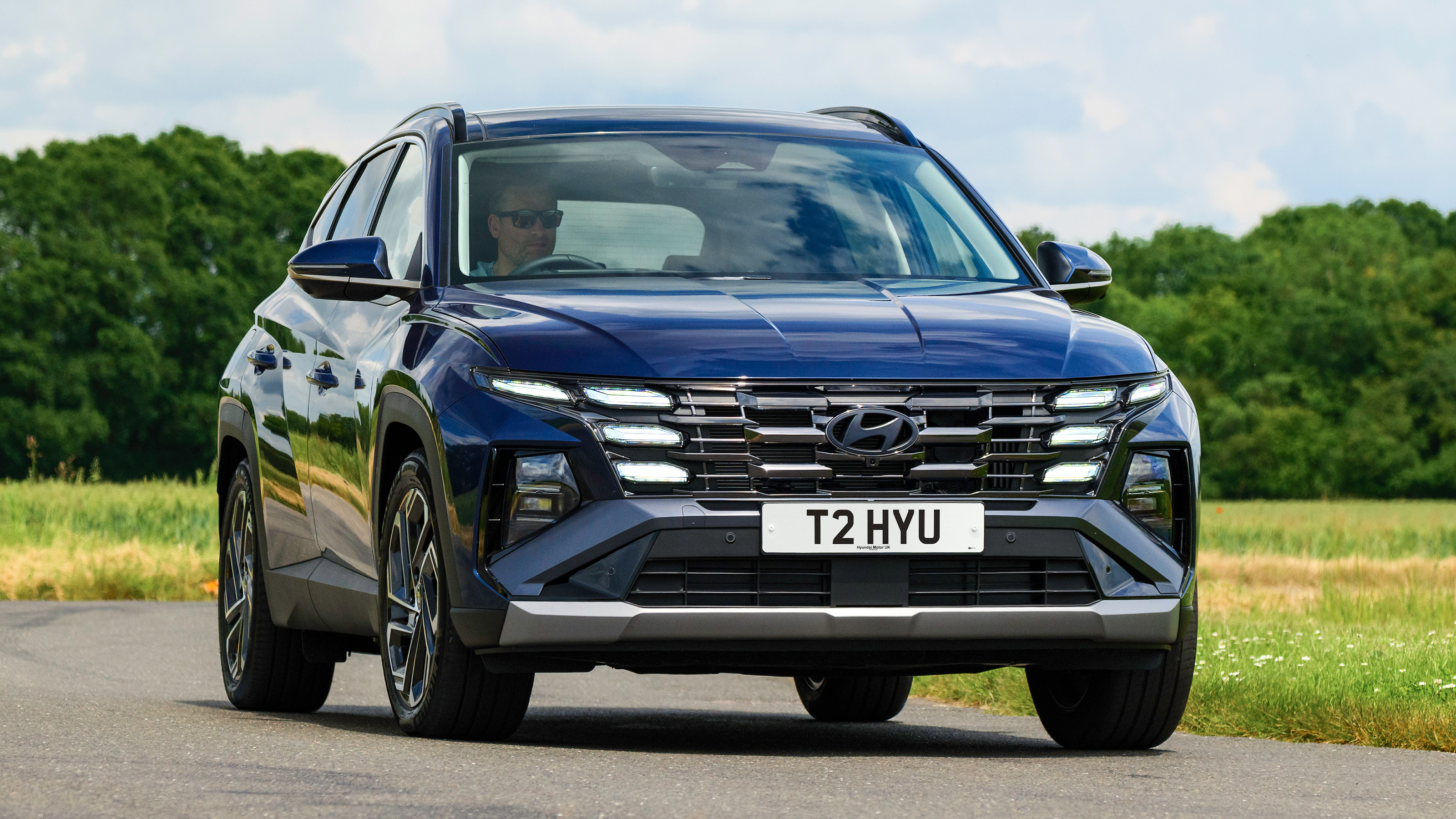
The 2026 Hyundai Tucson Hybrid keeps landing near the top of expert rankings for compact hybrid SUVs, and it's easy to see why. It pulls together things that were hard to find at this price only a few years ago: fuel economy in the high 30s, 226 horsepower, a 10-year, 100,000-mile powertrain warranty for the original owner that no direct rival matches, and cabin tech that feels like it belongs in a car costing $10,000 to $15,000 more. The one thing rankings don't fully capture is that Hyundai's track record past 100,000 miles isn't as well established as Toyota's or Honda's, and that matters if you plan to keep the car a long time.
The Tucson Hybrid doesn't deserve blind enthusiasm or too much caution. We'll give both sides a fair hearing. It's an excellent SUV with clear strengths and a few open questions worth understanding before you decide if it's right for you.
Score at a Glance
4.4 / 5.0 MenThemDrive Rating
Powertrain: 226 HP and High-30s MPG in Real Driving
The Tucson Hybrid pairs a 1.6-liter turbocharged four-cylinder with an electric motor and a small lithium-ion battery, for a combined 226 horsepower and 258 lb-ft of torque. Front-wheel drive is standard on some trims, and Hyundai's HTRAC all-wheel drive is standard or available on the rest, depending on the version.
Fuel economy is where it really delivers. The EPA rates the Tucson Hybrid at up to 38 mpg combined depending on trim, and its city and highway numbers are unusually close together, so long highway trips are almost as efficient as driving around town. Owners and independent testers commonly report the mid-to-high 30s in mixed driving. At 15,000 miles a year and $3.50 a gallon, 38 mpg works out to about $1,382 a year in fuel, compared with $1,875 for a 28 mpg non-hybrid SUV. That's roughly $490 a year saved, enough to cover the hybrid's extra cost over a gas Tucson in about four to five years.
Power delivery is smooth and linear. The electric motor gives instant torque from a stop, so there's none of the hesitation you get from many non-turbo engines at low speed, and the turbo builds power smoothly without the lag older turbo engines were known for. Zero to 60 takes roughly 7 seconds, not fast, but plenty for a family SUV, and noticeably quicker than the regular gas Tucson.
The Plug-In Hybrid Option: 33 Miles of Electric Range
The Tucson Plug-in Hybrid adds a much larger battery, around 13.8 kWh, good for about 33 miles of electric-only driving. That covers a typical daily commute for many drivers without using any gas. It costs several thousand dollars more than the regular hybrid and comes in a narrower range of trims.
If you can charge at home or work every day, the plug-in costs much less to run than the regular hybrid, because most of your miles run on electricity at $0.12 to $0.16 per kWh instead of $3.50 gas. Whether it pays off against the regular hybrid depends on your habits. Charge daily and do your commute on electricity, and the savings add up quickly. Charge only now and then, and you'll save much less.
Keep in mind that the $7,500 federal clean vehicle tax credit, which used to improve the math for some plug-in hybrids, ended for vehicles bought after September 30, 2025. Some states and utilities still offer incentives, so check what's available where you live.
Interior: The Category Where the Tucson Wins Most Clearly
Climb into a mid-level or higher Tucson Hybrid and the cabin is its most impressive feature. The materials, design, and amount of standard equipment regularly surprise reviewers who expect a mainstream brand to feel more budget. The 2025 refresh brought a new dashboard with a larger, wide-screen display that responds quickly, is logically laid out, and includes Apple CarPlay and Android Auto.
A few touches set the Tucson apart. Available ambient lighting gives the cabin a premium feel at night. Upper trims offer power front seats with ventilation as well as heating, something you usually only find in much pricier vehicles. And the available panoramic sunroof brightens the cabin and makes it feel more spacious on gray days.
Rear seat space is a strength too. With about 41 inches of rear legroom, the Tucson is one of the roomiest compact SUVs in back, close to the Honda CR-V and more generous than many rivals. Adults can ride comfortably back there on longer trips.
Technology Stack: Leading the Segment in Several Areas
Hyundai's Bluelink connected services let you remote start the car, pre-heat or cool the cabin from your phone, check the car's status, and on many trims use Hyundai's Digital Key, which lets a compatible phone lock, unlock, and start the car without the key fob. The Tucson also supports over-the-air software updates for some systems, a feature that's becoming more common but is still far from universal at this price.
Hyundai SmartSense driver assistance comes standard across the Tucson lineup. It includes Forward Collision-Avoidance Assist, Lane Keeping Assist, Lane Following Assist, Driver Attention Warning, Blind-Spot Collision Warning, and Rear Cross-Traffic Collision-Avoidance Assist. Lane Following Assist actively keeps the car centered in its lane on the highway, which goes a step beyond the simple lane departure warnings many rivals offer on base trims.
Safety Ratings
The Tucson has performed well in recent IIHS and NHTSA crash testing, earning strong ratings in major categories. As with many vehicles, headlight ratings can vary by trim, so the lighting on higher trims may score better than on base models. Check iihs.org and nhtsa.gov for the most up-to-date ratings on the exact 2026 model and trim you're considering. Its safety profile is competitive with the best in the segment and above average for compact SUVs overall.
The Reliability Question
This is the one area where a fair review of the Tucson needs some nuance that enthusiastic write-ups often skip. Hyundai's reliability has improved enormously since its reputation in the early 2000s, and recent Tucsons have generally scored well in reliability surveys. But the hybrid powertrain, the 1.6T engine plus hybrid system, has a shorter track record than Toyota's hybrid tech, which has been refined continuously since 1997.
Hyundai has also had well-known engine problems in the past, most notably with Theta II engines in many 2011 to 2019 models, which led to large recalls and extended warranties. The current 1.6T is a different engine, and its early record has been positive. But "a different engine with good early data" isn't the same as the decades of proven reliability past 150,000 miles that Toyota can point to. That difference matters most if you plan to keep the car ten years or more. For five to seven years of ownership, the Tucson's current record, backed by its long warranty, makes it a sound choice.
Warranty: The Strongest in the Segment
Hyundai backs the Tucson Hybrid with a 5-year, 60,000-mile basic warranty, a 10-year, 100,000-mile powertrain warranty, and 10-year, 100,000-mile coverage on hybrid components. That's much more than Toyota's 3-year, 36,000-mile basic and 5-year, 60,000-mile powertrain coverage, or Honda's matching terms. The gap matters most if you're the original owner and plan to keep the car seven to ten years. Hyundai's powertrain coverage lasts up to five years longer, and powertrain repairs between 70,000 and 100,000 miles can cost $2,000 to $6,000.
There's an important catch for used buyers. Hyundai's 10-year, 100,000-mile powertrain warranty only applies to the original owner. If you buy a used Tucson, the powertrain coverage typically drops to 5 years or 60,000 miles from the original sale date. The rest of the factory warranty generally carries over for the remaining time and mileage. So the long warranty is a big plus for new buyers, but less of an advantage when you buy used.
How the Tucson Compares to the RAV4 Hybrid and CR-V Hybrid
| Spec | 2026 Tucson Hybrid | 2026 RAV4 Hybrid | 2026 CR-V Hybrid |
|---|---|---|---|
| Base hybrid price | ~$33,400 | ~$31,900 | ~$35,600 |
| Combined HP | 226 hp | 226 hp (FWD) / 236 hp (AWD) | 204 hp |
| Combined MPG | Up to 38 mpg | Around 41 mpg (AWD) | 40 mpg (FWD) / 37 mpg (AWD) |
| Cargo (rear seats up) | About 38.7 cu ft | Competitive for class | About 36 cu ft |
| Rear legroom | About 41 in | Competitive for class | About 41 in |
| Warranty (powertrain) | 10yr/100k (original owner) | 5yr/60k | 5yr/60k |
| Hybrid battery warranty | 10yr/100k | 10yr/150k | 8yr/100k (longer in some states) |
Prices and figures are approximate and vary by trim. Check current specs before you buy.
The redesigned RAV4 Hybrid beats the Tucson on fuel economy and proven long-term reliability, and it has the longest hybrid battery warranty of the three. The Tucson beats the RAV4 on basic and powertrain warranty coverage for original owners and on cabin feel at similar trim levels. The CR-V Hybrid matches the Tucson on rear legroom and offers a very practical cargo area. None of them wins every category. The right choice depends on what matters most to you.
Verdict: Should You Buy the 2026 Tucson Hybrid?
Yes, if you plan to own it for five to seven years and care about technology, a quality interior, and the long warranty that no rival matches. The Tucson Hybrid is great value for the money, and that 10-year powertrain warranty gives you real financial protection while Hyundai's long-term reliability record keeps building. How it drives, how the cabin feels, and what comes standard all hold up against anything in the class.
Consider the RAV4 Hybrid instead if proven reliability past 100,000 miles is your top concern, or if you want the best fuel economy and a longer hybrid battery warranty. Consider the CR-V Hybrid if you want a smooth, EV-like drive and a very practical cargo area.
The trim to buy
For most buyers, a mid-level Tucson Hybrid with all-wheel drive is the value sweet spot. It gets you the larger touchscreen, wireless charging, heated seats, Digital Key, the full SmartSense safety suite, and HTRAC AWD without paying for top-trim extras like a panoramic sunroof or premium audio, which make less difference day to day. Compare trim packages carefully, because Hyundai's feature bundles change from year to year.
Detailed 5-Year Ownership Cost Analysis
The Tucson Hybrid's five-year ownership costs are competitive with the RAV4 Hybrid's, and in some scenarios better, even though the Tucson uses a little more fuel and doesn't carry Toyota's resale premium. The deciding factor is often the value of Hyundai's long powertrain warranty compared with buying extended coverage for a Toyota or from a third party.
Over five years at 15,000 miles a year, 38 mpg, and $3.50 a gallon, fuel comes to about $6,900. Insurance for a typical driver runs around $1,800 to $2,200 a year, or $9,000 to $11,000 over five years. Maintenance over that period, including regular oil changes, tire rotations, cabin and engine air filters, and brake checks, typically comes to about $1,500 to $2,200. Brake wear is lower than on a gas-only SUV thanks to regenerative braking. The long powertrain warranty also has real value if you keep the car past five years, since it can save you from paying for major repairs in years six through ten.
At five years, the Tucson Hybrid usually keeps a healthy share of its original price, a bit less than the RAV4 Hybrid's class-leading resale value but above the segment average. As Hyundai's reliability reputation keeps improving, that gap may shrink. For now, the slightly lower resale value is a small headwind in a five-year cost comparison, partly offset by a lower price at similar feature levels.
Driving Dynamics: Quieter and More Refined Than You'd Expect
The 2026 Tucson Hybrid benefits from a lot of work Hyundai has put into reducing noise and vibration over the past several years. It's quiet on the highway for its class, helped by acoustic glass on some trims, good body sealing, and the smooth-running 1.6T engine. Many drivers find it noticeably calmer at speed than some rivals.
The way it delivers power is worth describing, because it feels different from the RAV4 Hybrid in daily driving. The Tucson's turbocharged 1.6-liter engine has stronger midrange pull, which gives it more confidence when passing on the highway or darting through city traffic. The switch between electric and engine power is smooth in all but the coldest weather, and the battery provides enough electric assist to handle a lot of gentle low-speed driving.
The ride is comfortable for long highway drives. The suspension favors comfort over sporty handling, which suits a family SUV. It handles sharp potholes and expansion joints with good control, without the harsh thumps some rivals send into the cabin. The steering is accurate and nicely weighted, so highway lane changes feel confident without the heavy steering some drivers find tiring on long trips.
What Real Owners Are Saying After 12 Months
Owners of recent Tucson Hybrids report high satisfaction a year in, with the tech and fuel economy getting the most praise. Before the 2025 refresh, the most common complaint was the touch-sensitive climate controls on some trims, which were hard to use without looking away from the road. The refreshed dashboard brought back more physical controls, which fixes much of that frustration.
Reports from owners at 30,000 to 40,000 miles haven't turned up any widespread problems, a good early sign. But that's still too early to judge how the car will hold up past 100,000 miles, where Toyota's data runs much deeper. Hyundai uses versions of the same basic hybrid layout in several of its hybrid models, which gives it a growing base of real-world experience.
Buying a Used Tucson Hybrid
The current-generation Tucson Hybrid arrived for the 2022 model year, so there are plenty of used examples around, often thousands of dollars below the price of a new one. A well-kept 2022 or 2023 model with moderate mileage can be a strong value.
When you look at a used Tucson Hybrid, remember that the 10-year, 100,000-mile powertrain warranty only covers the original owner. As a second owner, you'll usually get 5 years or 60,000 miles of powertrain coverage from the original sale date. Check what's left of the warranty with a Hyundai dealer using the VIN. Look up open recalls and service bulletins for that model year on nhtsa.gov, and ask for service records showing regular oil changes. A used Tucson Hybrid with a clean history report, documented maintenance, and some factory warranty remaining is one of the better deals in used compact hybrid SUVs.
Final Word
The 2026 Hyundai Tucson Hybrid earns its strong rankings, and our 4.4 out of 5, on genuine quality, not just because it's in a popular class. With 226 horsepower, fuel economy in the high 30s, excellent tech, a roomy rear seat, and the strongest warranty in its class for original owners, it's a very compelling choice for anyone planning to own a car for five to seven years. The one caveat, that Hyundai's reliability record past 100,000 miles is still being built compared with Toyota's decades of data, is worth knowing but shouldn't be blown out of proportion. Drive it back to back with the RAV4 Hybrid and CR-V Hybrid, and you'll see what the specs suggest: the Tucson Hybrid is one of the most feature-packed, tech-forward, and warranty-protected hybrid SUVs you can buy in 2026.