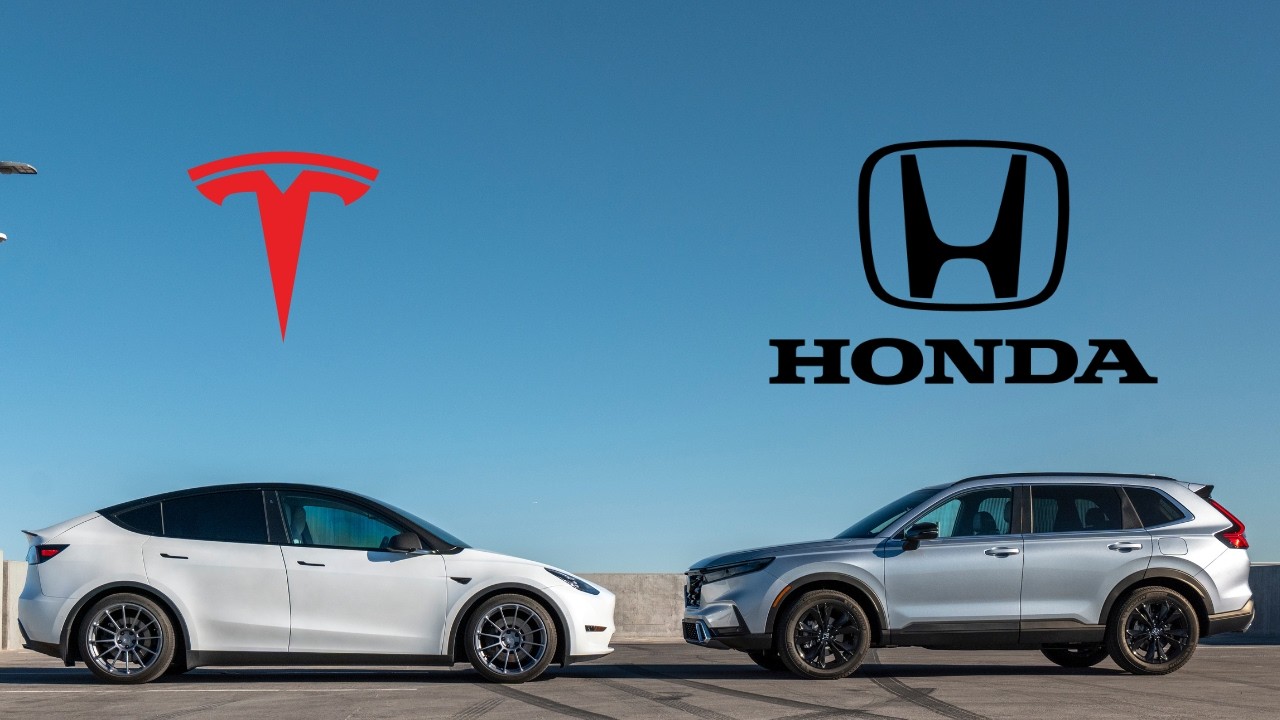
The Tesla Model Y and the Honda CR-V Hybrid sit right where two big shifts in the car world meet: the move to full electric, and the staying power of proven hybrid tech. Real families cross-shop these two every day, and which one is better depends on who's asking. Instead of crowning a winner that doesn't exist, we'll lay out the full picture so you can work out which answer fits you.
They're about the same size and aimed at the same family SUV buyer, and with the new Model Y Standard AWD, they can even cost about the same. But they come from very different ideas about what a car should be, how it should work, and what owning one should feel like. Both are excellent. Neither is right for everyone.
Specs Side-by-Side
| Specification | Tesla Model Y Premium AWD | Honda CR-V Hybrid Sport-L |
|---|---|---|
| Starting price | $49,990 (Standard AWD from $41,990) | About $41,675 |
| Drivetrain | Dual-motor electric AWD | 2.0L hybrid, 204 hp combined, AWD |
| 0–60 mph | About 4.6 sec | About 7.6 sec |
| Range / fuel economy | 327 miles EPA | 37 mpg combined EPA (AWD) |
| Cargo (rear seats up) | About 30 cu ft | About 36 cu ft |
| Cargo (rear seats folded) | About 68 cu ft (plus frunk) | About 76 cu ft |
| Frunk | About 4 cu ft | None |
| Towing capacity | 3,500 lb | 1,500 lb |
| Warranty | 4yr/50k basic, 8yr/120k battery | 3yr/36k basic, 5yr/60k powertrain |
| Charging/refueling | Supercharger network, up to 250 kW | Gas station, 3–5 min |
Specs and prices are approximate and change with model year updates, so check current figures before buying.
The 5-Year Cost Comparison
Start with the purchase price. The federal $7,500 EV tax credit ended for vehicles bought after September 30, 2025, so 2026 buyers pay full price. The Model Y Premium AWD starts at $49,990 and the CR-V Hybrid Sport-L at about $41,675, so the Tesla costs roughly $8,300 more. Tesla's newer Model Y Standard AWD, at $41,990, cuts that gap to a few hundred dollars, at the cost of less range and fewer features. We'll use the Premium AWD as our main example and come back to the Standard below.
Fuel. At 15,000 miles a year, the Model Y at 3.5 miles per kWh and $0.16 per kWh uses about $686 of electricity a year. The CR-V Hybrid AWD at 37 mpg and $3.50 a gallon uses about $1,419 of gas. That's about $733 a year in the Tesla's favor, or roughly $3,665 over five years.
Maintenance. The Tesla needs no oil changes and wears its brakes much more slowly thanks to strong regenerative braking. The CR-V Hybrid needs regular oil changes and more routine service. Over five years, expect the Tesla to save somewhere around $1,000 to $1,500 in maintenance.
Insurance. For a 35-year-old driver in a moderately priced state, insuring a Model Y typically costs $2,200 to $2,800 a year, compared with $1,400 to $1,800 for a CR-V Hybrid. Over five years, that's about $4,000 to $5,000 more for the Tesla. Get real quotes, because your number could be quite different.
Depreciation. Tesla's history of sharp price cuts has made its resale values less predictable, while the CR-V Hybrid has some of the strongest resale values in its class. Over five years, the Tesla will probably lose more of its value, both in percentage and in dollars.
Putting it together, the Tesla's fuel and maintenance savings (roughly $4,500 to $5,000) are more than offset by higher insurance and a higher purchase price that loses more value over time. In our estimate, the Model Y Premium AWD costs roughly $8,000 more to own over five years than the CR-V Hybrid Sport-L. With the cheaper Model Y Standard AWD, the gap shrinks to around $3,000. The full breakdown is in the final numbers section below.
Daily Driving: Where They Differ Most in Practice
For everyday driving, meaning commutes, school runs, grocery trips, and weekend errands, the CR-V Hybrid is the easier experience for most families. You stop for gas every week or two, it takes four minutes, and the car behaves the same whatever the weather or whether you remembered to do anything the night before. Driving it feels normal and familiar to anyone who's driven a car in the last 30 years.
Daily life with the Tesla is better in some ways and worse in others. The good: a full battery every morning if you charge at home, instant torque that makes merging and passing effortless, over-the-air updates that keep improving the car, and a screen-based interface that many people end up liking once they're used to it. The not so good: keeping track of charging if you can't charge at home, range that drops noticeably in winter, and a few weeks of getting used to controls that work differently from most cars.
If you can charge at home on Level 2, the Tesla's daily experience is arguably better, since you never have to plan a fuel stop. If you'd rely on public charging, the CR-V Hybrid's quick, simple refueling is a big and very real advantage.
Cargo and Family Practicality
The CR-V Hybrid has more cargo space than the Model Y where it counts for families. Behind the rear seats, the CR-V offers about 36 cubic feet to the Tesla's roughly 30, close to 20% more room for groceries, sports gear, and strollers. With the rear seats folded, the CR-V has about 76 cubic feet to the Model Y's roughly 68, not counting the Tesla's frunk. The CR-V's boxier cargo area is also easier to load with tall items than the Model Y's sloped rear hatch.
The Tesla fights back with its front trunk, or frunk, which is handy for keeping groceries away from muddy boots, stashing charging cables, or hiding things out of sight. No regular SUV has one. It doesn't make up for the CR-V's bigger rear cargo area, but it's a useful extra the Honda can't match.
Both have enough rear seat room for adults. The CR-V's rear seat reclines, and its back doors open very wide, which makes loading car seats easy. The Model Y's rear seats fold electrically and its glass roof makes the back feel airy, and tall passengers generally fit well in both.
Technology and Software
Tesla clearly wins on technology. Its big center screen pulls vehicle controls, navigation, entertainment, and settings into one system, over-the-air updates add real improvements and new features, and Autopilot driver assistance is standard. The CR-V's more conventional setup can't match that level of sophistication.
A few Tesla standouts: navigation that plans charging stops for you, warms the battery for faster charging on the way, and tells you how much charge you'll arrive with. Sentry Mode, which records what happens around the car when it's parked. Dog Mode, which keeps the cabin comfortable for a pet and shows a message on the screen so passersby know the dog is fine. And a steady stream of software updates that have improved efficiency, driver assistance, and features over the years.
The CR-V Hybrid's Honda Sensing safety suite works well for a conventional system, and its touchscreen with wireless Apple CarPlay and Android Auto gives you a familiar, phone-friendly setup that many drivers prefer to Tesla's in-house system, which doesn't offer CarPlay at all. The Honda is less advanced overall, but easier to pick up right away if you like physical buttons and familiar controls.
Reliability: Proven vs Maturing
Honda's reliability reputation is among the best in the industry, built over decades. The CR-V in particular has a strong record across several generations, owners rate it highly in long-term surveys, and the Honda's hybrid system and electronics are well understood by independent repair shops.
Tesla's reliability picture is more mixed. The electric drivetrain has very few moving parts and has held up well over the long run. Tesla's weaker spots have been panel gaps and fit and finish that varies from car to car, interior trim quality, and the electronics and software that control more and more of the car. Reliability surveys have often rated the Model Y below average, mostly because of body and trim issues, not the powertrain. These aren't usually safety problems, but they can affect how happy you are with the car and what it's worth later.
Road Trips: The Most Concrete Difference
On road trips, these two feel very different, and for people who travel a lot, that can decide it.
A Tesla road trip on the Supercharger network is excellent. Enter your destination, the navigation picks charging stops for you, the battery warms up on the way to each charger, and you just pull in and plug in, with no separate app or payment. A typical stop takes 20 to 25 minutes, about the length of a bathroom and coffee break, and Superchargers are known for being reliably available and working. On a 600-mile trip you might make one or two stops and spend maybe 20 to 40 minutes more than you would in a gas car. That's real, but modest if you only road trip now and then.
A CR-V Hybrid road trip is like any gas car's. You fill up every 400 miles or so, spend a few minutes at the pump, and keep going. No planning, no charging network, nothing to think about. If you often drive long distances, especially into rural areas with few chargers, that simplicity is worth a lot.
Who Should Buy the Tesla Model Y
The Model Y makes the most sense if you have Level 2 charging at home (or will install it right away); your driving is mostly commuting and local trips with the odd long drive; you enjoy technology and like a car that keeps getting software updates; performance matters to you and you'll enjoy that quick acceleration; you tow light trailers and want the higher towing rating; and you're comfortable with a brand that takes some getting used to and has had some inconsistency in build quality.
Who Should Buy the CR-V Hybrid
The CR-V Hybrid makes more sense if you can't charge at home or live in an apartment; you take long road trips often or regularly drive in rural areas; you want the easiest ownership with quick fill-ups and familiar tech; you want the lowest five-year cost, helped by cheaper insurance and strong resale value; you need the most cargo space for family life; you want Apple CarPlay or Android Auto; and you'd rather have Honda's long reliability record than Tesla's more variable one.
The Honest Verdict
For many American families who can charge at home, drive a normal mix of commuting and errands, and take a few road trips a year, the Tesla Model Y is the more exciting car to own, even though it costs more. Its technology, its charging network for those longer trips, its performance, and the everyday convenience of charging at home make it more satisfying for that kind of driver.
For buyers without home charging, frequent long-distance drivers, anyone focused on total cost, and people who simply prefer conventional tech and Honda's reliability record, the CR-V Hybrid isn't a compromise. It's the better choice. More cargo space, a lower total cost of ownership, and hassle-free everyday use make it the winner for those buyers.
Both are excellent and will serve their owners well. The right one depends on which kind of buyer you are.
Resale Value: The Uncertain Variable That Changes the Math
Resale value is the hardest part of any five-year comparison to predict, and it has the biggest effect on the Tesla's numbers. Tesla has cut new car prices sharply more than once, including big Model Y price drops in 2023 and 2024, and each cut pulled down what existing owners could get for their cars. Many owners who bought at the peak saw their resale values fall far faster than normal depreciation would explain, mainly because of Tesla's own pricing decisions.
The market has shifted again since then. Tesla revamped the Model Y lineup, added cheaper Standard versions, and the federal EV tax credit ended in September 2025, all of which affect used prices. Used Model Y values have steadied compared with their lows, but the risk that Tesla's pricing moves will hit resale values is still higher than with traditional automakers, which don't change prices as sharply or as often. If resale uncertainty worries you, the CR-V Hybrid's consistently strong resale value is the safer bet.
Maintenance: The EV Advantage Quantified
The Model Y and CR-V Hybrid are both cheap to maintain compared with a typical gas car. The difference between them is real but smaller than the gap between an EV and a regular gas car.
Tesla Model Y over five years and 75,000 miles: no oil changes, much less brake service thanks to regenerative braking (the first brake job often doesn't come until well past 60,000 miles), tire rotations, cabin air filters, and wiper blades. Estimated five-year total: $600 to $900, plus tires.
CR-V Hybrid over five years and 75,000 miles: oil changes roughly every 7,500 miles (about 10 services at around $80 each, or $800), brake service somewhere around 45,000 miles or later ($250 to $400), tire rotations, cabin and engine air filters, and coolant service. The hybrid's regenerative braking also helps the brakes last, just not as much as the Tesla's stronger regen. Estimated five-year total: $1,800 to $2,400, plus tires.
The Tesla's $1,000 to $1,500 maintenance advantage over five years is real, but higher insurance costs ($4,000 to $5,000 more over five years) cancel it out, and it doesn't change the overall financial picture much.
The Final Numbers for Both Buyer Profiles
Here's the estimate for a buyer who charges at home, drives 15,000 miles a year, and keeps the car for five years:
Tesla Model Y Premium AWD: $49,990 purchase + $3,430 electricity + $12,500 insurance + $750 maintenance − about $22,500 resale value = roughly $44,170 net cost. CR-V Hybrid Sport-L: $41,675 purchase + $7,095 fuel + $8,000 insurance + $2,100 maintenance − about $22,900 resale value = roughly $35,970 net cost. That puts the CR-V Hybrid ahead by about $8,200 over five years. In return, the Tesla owner gets a quicker, more tech-heavy car with Supercharger access. Whether that's worth the extra money is a personal call.
With the Model Y Standard AWD at $41,990 instead, the math gets much closer. Assuming a lower resale value of around $19,000 and slightly lower insurance, its five-year net cost comes to roughly $39,000, about $3,000 more than the CR-V Hybrid. For a car that's quicker and costs very little to fuel, some buyers will see that as a fair trade.
For a buyer without home charging who uses public fast chargers for most of their driving, it's a very different story. At around $0.42 per kWh, the Tesla's yearly "fuel" bill rises to about $1,800, or roughly $9,000 over five years, more than the CR-V Hybrid spends on gas. In that case, the CR-V Hybrid's five-year advantage over the Model Y Premium grows past $10,000. Without home charging, the financial case for the Tesla falls apart.
Quick Decision Summary
If you can charge at home and mostly drive locally with the odd road trip, the Tesla Model Y is the more rewarding car to own, and the Standard AWD keeps the price close to the CR-V. If you can't charge at home or often drive to rural areas with few chargers, get the CR-V Hybrid. If you want the lowest total cost, the CR-V Hybrid wins in almost every scenario now that the federal EV credit is gone. If cargo space for family hauling comes first, the CR-V Hybrid wins by about 6 cubic feet behind the rear seats. If technology, performance, and a car that keeps improving through software matter most, the Tesla Model Y wins clearly. Neither is a wrong choice. Only one is right for you.
The Ownership Ecosystem: What Comes With Each Vehicle
Beyond the car itself, each one comes with its maker's ecosystem, and that shapes ownership too. Tesla's includes the Supercharger network covered throughout this comparison, a phone app for remote monitoring, pre-heating or cooling the cabin, and managing charging, and over-the-air updates that have been improving Tesla cars for more than a decade. In some states, Tesla also offers its own insurance, which prices your policy partly on how you actually drive and can be cheaper for careful drivers.
Honda's ecosystem is more traditional. The Honda app handles remote start, locking and unlocking, and checking the car's status, such as fuel level and maintenance reminders. You get roadside assistance for the first three years, and a large network of Honda dealers across the country, with technicians trained on the hybrid system. Some buyers prefer that familiar setup once the novelty of Tesla's app-driven approach wears off. Having independent dealers also gives you more options if you ever disagree about repairs or warranty coverage, compared with Tesla's company-owned service centers, where there's nowhere else to go.