Tires are the only part of your car that touches the road, and they wear out so gradually that most drivers never notice until something goes wrong in the rain. The checks that tell you when to replace them take about five minutes and need nothing more than a coin and some daylight.
Here's how to judge tread depth, how to work out how old your tires are, and the damage that means replacing them today rather than at the next service.
Tread Depth: The Number That Matters Most
Tread grooves exist to channel water out from under the tire. As they wear down, less water can escape, and the tire is more likely to skim across the surface instead of gripping it. That's hydroplaning, and it's the main reason worn tires are dangerous long before they look bald.
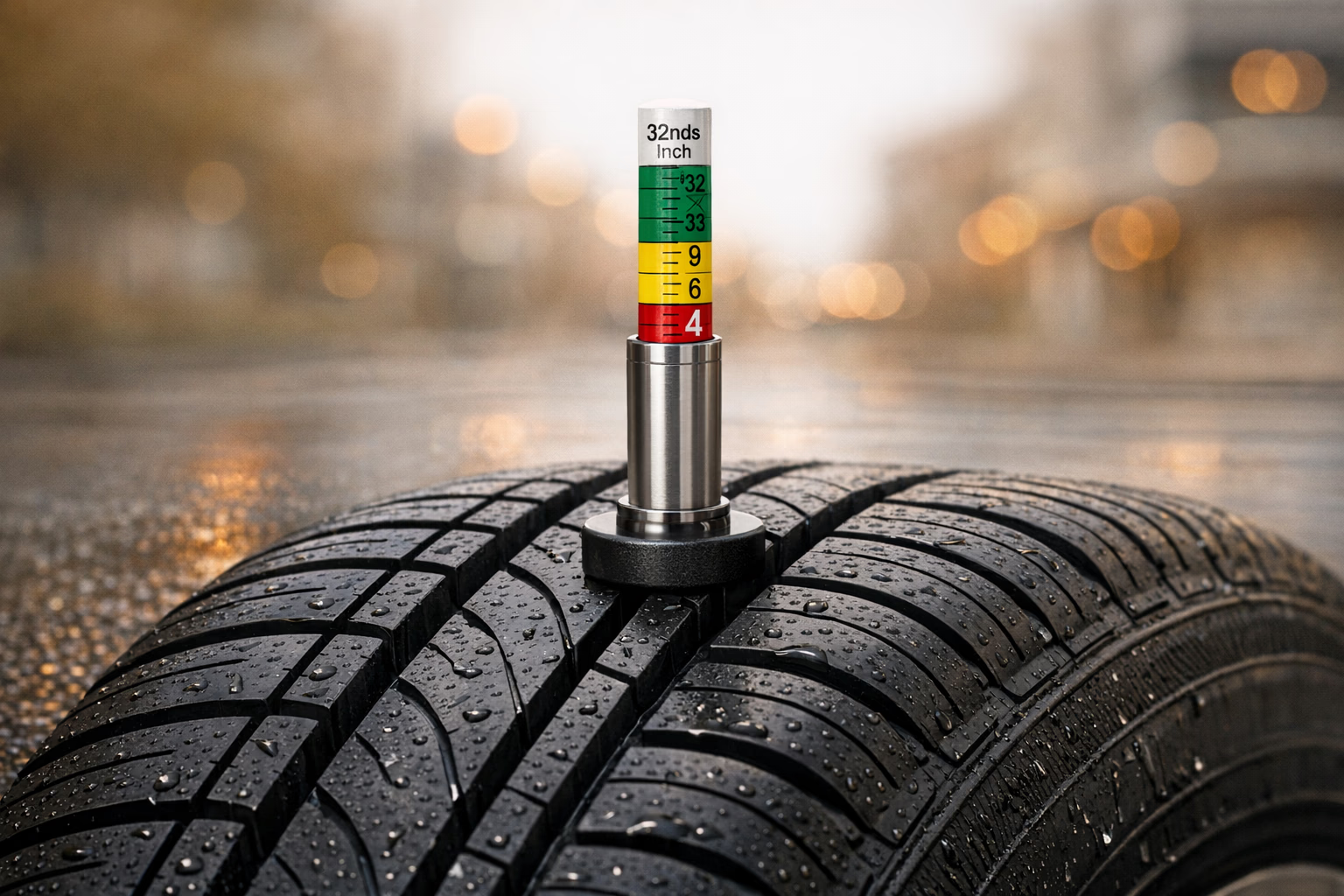
Tread depth is measured in 32nds of an inch. A new tire usually starts around 10/32" to 11/32". In most states, the legal minimum is 2/32", though California and Idaho set it at 1/32". Legal, though, is not the same as safe. By the time a tire is at 2/32", wet braking distances have increased dramatically.
Tire professionals commonly recommend replacing at 4/32" if you drive in rain, and at 6/32" if you drive in snow, where deeper tread is needed to bite into loose surfaces.
The Penny and Quarter Tests
You don't need a gauge. Two coins will do.
The penny test checks the legal limit. Put a penny into a tread groove with Lincoln's head upside down and facing you. If you can see the top of his head, the tread is at or below 2/32" and the tire is finished. Replace it now.
The quarter test checks the safer threshold. Insert a quarter with Washington's head upside down. If the top of his head is visible, you're at or below 4/32", which is when most experts suggest replacing tires used in wet conditions.
Check in several places on each tire: both outer edges and the middle, and at a few points around the circumference. Tires rarely wear evenly, and one worn section is enough to warrant replacement. A proper tread depth gauge costs only a few dollars if you'd rather have a number than a coin.
Every tire also has built-in wear bars, small raised strips running across the bottom of the grooves. When the tread wears flush with those bars, the tire is at 2/32" and is legally worn out.
Tire Age: The Limit People Forget
Rubber ages whether you drive on it or not. Over the years it hardens and loses grip, and the structure inside can weaken even when the tread looks almost new. This catches out owners of low-mileage cars, weekend vehicles and campers, and it's the reason a spare tire that has never touched the road can still be unsafe.
To find a tire's age, look for the DOT code on the sidewall. The last four digits give the week and year it was made. A tire marked 2823 was built in the 28th week of 2023. If the code has only three digits, the tire dates from the 1990s and should have been replaced long ago.
There's no single legal expiry date in the US, but the common guidance is this: have tires inspected annually once they pass five or six years, and replace them by ten years at the latest, whatever the tread looks like. Many automakers recommend six years. If your tires are older than six and you don't know their history, get a tire shop to look at them.
Damage That Means Replace Now
Some problems don't wait for the next service. Replace the tire straight away if you find:
- A bulge or bubble in the sidewall. This means the internal structure has failed, usually after hitting a pothole or curb. It can blow out without warning.
- Cracks in the sidewall or between tread blocks. Fine cracking, sometimes called weather checking, points to age or long sun exposure.
- A cut or puncture in the sidewall or shoulder. Only punctures in the central tread area can be safely repaired, and only if they're small.
- Exposed cords or steel belts. The tire is finished.
- A puncture that's been plugged repeatedly, or repaired with a plug from outside without the tire being removed and patched properly from inside.
- Vibration that appeared suddenly. It may be a balance issue, but it can also mean internal damage, so have it checked.
A flat repaired properly by a tire shop, with a combination patch and plug from the inside, is safe. A roadside plug should be treated as a temporary fix.
What Uneven Wear Is Telling You
How a tire wears points to what's wrong with the car, and replacing tires without fixing the cause just wears out the new set.
- Both edges worn, center fine: chronic under-inflation.
- Center worn, edges fine: chronic over-inflation.
- One edge worn: a camber or alignment problem.
- Feathered or saw-toothed edges: usually a toe alignment problem.
- Patchy, cupped wear: often worn shocks or struts, or wheels out of balance.
If you see any of these, get an alignment check and a suspension inspection along with the new tires. Regular rotation also spreads wear evenly, and our tyre rotation guide explains the right interval and pattern for your drivetrain.
Do You Have to Replace All Four?
Not always, but there are rules worth following.
Replace tires in pairs at minimum, on the same axle, so both sides have similar grip. Put the newer pair on the rear, even on a front-wheel-drive car. It sounds backwards, but worn rear tires make a car much more likely to spin in the wet, and most drivers find that far harder to control than losing front grip.
On all-wheel-drive vehicles, check the owner's manual before replacing fewer than four. Many AWD systems are sensitive to differences in tire diameter between axles, and a mismatch can damage the driveline. Some manufacturers specify replacing all four, or shaving a new tire to match the worn ones.
Pressure and Rotation Make Tires Last Longer
Correct pressure is the cheapest way to get more life out of tires. Check monthly, in the morning before driving, since pressures read higher when warm. Use the figure on the sticker in the driver's door jamb, not the number moulded into the tire sidewall, which is the tire's maximum, not your car's recommended pressure.
Under-inflated tires wear at the edges, run hot, and use more fuel. Over-inflated tires wear in the middle and ride harshly. Both shorten tire life, and both are avoidable in two minutes a month. For more short jobs that save money, see our DIY maintenance checklist.
The five-minute check worth doing tonight
Take a quarter to each tire. Check the outer edge, center and inner edge on all four. If Washington's head shows anywhere, start shopping. While you're down there, look for bulges and cracks, and read the last four digits of the DOT code to see how old the tires are. That's the whole inspection, and it catches nearly every problem that matters.
Buying Replacements Without Overspending
Match the size on your door jamb sticker, including the load index and speed rating. Going below the specified ratings is a safety problem, and it can affect insurance claims.
Beyond that, buy the best all-season or winter tire you can afford in the right size. Independent wet braking and hydroplaning tests separate good tires from bad ones far better than price alone does, and the difference between a strong tire and a cheap one can be several car lengths in an emergency stop. The NHTSA tire safety pages explain the ratings printed on the sidewall and how to read them.
Shops often run rebates that make a better tire cost about the same as a budget one. And if your car is going into winter in a snowy region, a set of dedicated winter tires will do more for safety than almost any other money you spend on the car.
All-Season, Winter or All-Weather?
Most cars leave the factory on all-season tires, which are a compromise: acceptable in most conditions, excellent in none. They harden as temperatures drop, and below about 45°F they lose grip even on dry pavement.
Winter tires use a softer compound and far more biting edges. In snow and ice they're transformative, and they outperform all-seasons even on cold, dry roads. If you live somewhere with real winters, a set of winters on their own wheels is the best safety upgrade you can buy, and it extends the life of your summer or all-season set at the same time.
All-weather tires sit in between and carry the three-peak mountain snowflake symbol, meaning they meet a snow traction standard. They're a reasonable single-set choice for regions with occasional snow.
Look for that snowflake symbol on the sidewall if winter traction matters. The older M+S (mud and snow) marking is far less demanding and doesn't mean the same thing.
Don't Forget the Spare
If your car has a spare, check it when you check everything else. Spares lose pressure sitting untouched, and a flat spare is no use at the roadside. Compact "donut" spares also have strict limits, usually around 50 mph and 50 miles, which is enough to reach a tire shop and no further.
Spares age like any other tire, so a ten-year-old spare should be replaced even if it has never touched the road. Many newer cars have no spare at all, just a sealant kit and a compressor. If that's your car, check that the sealant hasn't expired, because it has a shelf life of a few years.
What a Good Tire Shop Should Do
Fitting tires properly matters as much as choosing them. A competent shop will balance each wheel, reset or service the TPMS sensors, fit new valve stems where needed, and torque the lug nuts with a torque wrench rather than an impact gun. Over-tightened lug nuts can warp brake rotors and damage studs.
Ask them to check alignment at the same time, especially if the old tires wore unevenly. Fitting new tires to a car that's out of alignment is an expensive way to ruin a new set. You should also expect to be shown the old tires and told what the wear pattern indicated.
What Replacement Costs
For a common 17 or 18-inch size on a mainstream car, budget roughly $150 to $250 per tire for a good all-season, plus $20 to $35 per tire for mounting, balancing and disposal. That puts a full set somewhere around $700 to $1,100 installed. Larger wheels, performance tires and run-flats cost significantly more.
Two ways to keep the bill down without buying poor tires: watch for manufacturer rebates, which are common in spring and fall, and compare a tire shop's out-the-door price with the online retailers that ship to a local installer. Just don't buy on price alone. Wet braking performance varies enormously between tires that cost nearly the same, and it's the one difference you'll notice when it matters most.
The Bottom Line
Replace your tires when tread reaches 4/32" if you drive in rain, sooner if you drive in snow, and immediately if you find a bulge, sidewall damage or exposed cords. Replace them by ten years old regardless of tread, and have them checked annually once they pass six.
Everything else is upkeep: correct pressure, regular rotation, and fixing alignment problems when they show up. Do that, and you'll get every mile your tires were built to deliver, and you'll know exactly when their time is up.