Tyre rotation is one of the maintenance jobs people skip most. It doesn't feel as pressing as an oil change, it can mean booking a separate appointment, and you don't see the cost of skipping it until the bill arrives. No warning light tells you the front tyres are wearing unevenly. By the time you notice, you've usually lost 20 to 40% of the tyres' expected life, on a set that costs $600 to $1,200 to replace.
The numbers are easy to follow. Take an $800 set of all-season tyres rated for 60,000 miles. Rotated regularly, they cost about 1.3 cents per mile. Skip rotation and uneven wear might force you to replace them at around 42,000 miles, which works out to about 1.9 cents per mile. Over 60,000 miles of driving, that's roughly $340 more spent on tyres. Rotating every 6,000 miles comes to nine rotations. If you bundle them with oil changes for $0 to $25 each, the most you'll pay is about $225, so rotation comes out ahead even before you count the better handling and wet grip of evenly worn tyres.
How Tyres Wear Differently by Position
Once you know why each corner of the car wears its tyres differently, it's clear why rotation helps and why the right pattern depends on your drivetrain.
On every car, the front tyres do most of the steering. Each lane change, turn, and correction pushes sideways on the fronts and scrubs rubber off the edges of the tread. Weight shifts forward when you brake, so the front tyres also handle most of the braking force, which wears them faster than the rears. On a front-wheel-drive car, the fronts also put all the engine's power down, so they wear much faster than the rears.
On a rear-wheel-drive car, the rear tyres put the power down, so they tend to wear faster than the fronts. All-wheel drive spreads wear more evenly, but not perfectly. Many systems send more power to the rear in normal driving (a 40/60 front/rear split is common), yet the fronts still carry all the steering load, so they usually wear a bit faster.
What does that mean in practice? Without rotation, the front tyres on a FWD car wear about twice as fast as the rears. You'd need a new front pair at 30,000 to 35,000 miles while the rears still had half their tread left. Rotating evens out wear across all four positions, so all four tyres wear out at about the same time and you replace them as a set, getting the most miles out of what you paid for.
How Often to Rotate: The Correct Frequency
Tyre makers, carmakers, and the U.S. Tire Manufacturers Association all give the same basic advice: rotate every 5,000 to 7,500 miles. Lots of shops shorten that to "every oil change," which works well if you change oil every 5,000 to 7,500 miles. If you're on a 10,000-mile oil interval, which is common with full synthetic, either rotate at every other oil change (every 5,000 miles) or book a rotation every six months no matter the mileage.
Tying rotation to oil changes only works if the timing lines up. If your oil changes are spaced further apart than 7,500 miles, "I'll do it next oil change" is how rotations get skipped. Put a reminder in your phone that matches your real oil change interval.
Some cars do better with more frequent rotation, every 4,000 to 5,000 miles. That includes sports cars on soft summer performance tyres, which wear quickly; vehicles that tow, since the load wears the rear tyres faster; and FWD cars with torquey engines, where hard acceleration eats the front tyres.
Rotation Patterns by Drivetrain Type
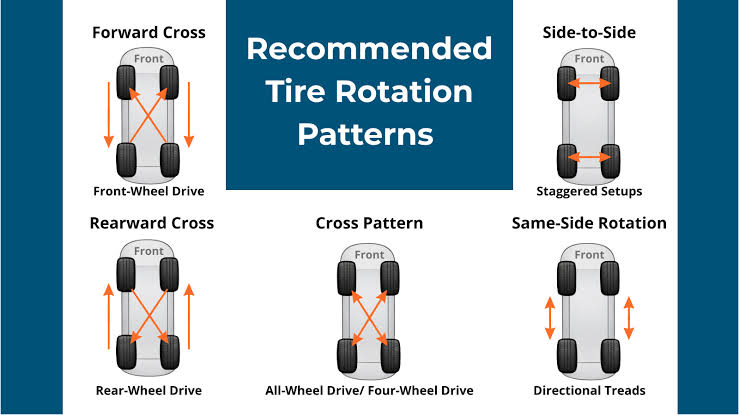
The rotation pattern, meaning where each tyre goes, depends on your drivetrain and on whether your tyres are directional. Use the wrong pattern and you can create new wear problems.
Front-Wheel Drive: Forward Cross Pattern
For FWD cars with non-directional tyres, the front tyres move straight back to the rear on the same side, and the rear tyres cross over to the opposite front corners. This is often called the Forward Cross. The hard-working fronts get a break at the back, and the lightly worn rears move up front where they'll wear faster, which evens out wear over several rotations.
In short: driver's front goes to driver's rear, passenger's front goes to passenger's rear, driver's rear goes to passenger's front, and passenger's rear goes to driver's front.
Rear-Wheel Drive: Rearward Cross Pattern
For RWD cars, and AWD cars that send most of their power to the back, it's the reverse. The rear tyres move straight forward on the same side, and the front tyres cross to the opposite rear corners. That suits the heavier wear that driven rear tyres usually get.
All-Wheel Drive: The X-Pattern
Most tyre and car makers recommend the X-Pattern for AWD vehicles. Every tyre moves diagonally, swapping both side and axle at once: driver's front to passenger's rear, passenger's front to driver's rear, and the rears cross to the front the same way. It gives the most even wear across all four corners, which is important because many AWD systems don't cope well with tyres of different diameters.
That sensitivity to tyre diameter needs a closer look. Many AWD systems, especially ones that use an electronically controlled clutch pack instead of a traditional center differential, can be damaged when front and rear tyres differ noticeably in size. If one tyre is much more worn than the others, it's effectively smaller and spins at a different speed, and the AWD system has to make up the difference all the time. That creates heat and wear inside the coupling. Rotating regularly keeps all four tyres at similar tread depths and avoids the problem. Some manufacturers, Subaru and Audi among them, say outright that a difference of more than 2/32" to 3/32" between axles needs to be checked and corrected right away.
Staggered Fitment: When You Can't Rotate the Normal Way
Some performance cars run wider tyres at the back than the front. This is called a staggered setup. A Porsche 911 might run 245-width tyres up front and 305s at the rear, and a BMW M3 might have 255s up front and 285s at the back. Those tyres can't swap axles, because they won't fit the other axle's wheels without hitting the bodywork or brakes.
With a staggered setup and non-directional tyres, you can only rotate side to side: driver's front swaps with passenger's front, and driver's rear swaps with passenger's rear. That helps even out left-right wear caused by the camber of the road, but it does nothing about front-rear differences. Expect the rear tyres on these cars to wear faster and to need replacing more often than the fronts.
If the tyres on a staggered car are also directional, you can't rotate them at all without taking each tyre off its wheel and remounting it for the other side. That needs a tyre machine and rebalancing and usually costs $20 to $30 per corner. If you own a car like this, accept that the rears will go first, budget for it, and keep the pressures spot-on, since correct inflation is the best tool you have for keeping wear even.
What Rotation Costs and Where to Get the Best Value
Here's what rotation typically costs in 2026: $20 to $50 at quick-lube chains like Jiffy Lube, Valvoline, and Firestone; often free at Costco if you bought your tyres there; $0 to $25 at dealers when combined with an oil change; and $50 to $80 at independent shops as a standalone job. For most people, the cheapest route is Costco (free with a tyre purchase) or a dealer oil change package that includes rotation.
Be wary of shops that offer "free" rotation but tighten lug nuts without a torque wrench, since overtightened nuts can damage wheel studs and warp brake rotors. Also watch for shops that don't check pressures afterward. Some cars use different front and rear pressures, and a little air can be lost during the job, so pressures need checking after every rotation. It's fair to ask any shop, "Do you torque the lug nuts to spec and check pressures after rotating?"
What to Inspect at Every Rotation Appointment
A rotation is the best chance to look at the brakes, suspension, and wheel bearings, because every wheel comes off. A decent tech will glance at them. A good one will check them properly. If your shop doesn't include a brake check with rotation, ask for one. It takes about five extra minutes and has caught plenty of brakes close to failing that the driver had no idea about.
At a minimum, every rotation should include:
- Tread depth measured on all four tyres with a proper gauge, not by eye. The legal minimum is 2/32", but for safety most experts suggest replacing at 4/32" for rain and 6/32" for snow.
- A check of the sidewalls for cracks, bulges, or damage.
- A look at brake pad thickness and rotor condition.
- Tyre pressures checked and set after the wheels go back on.
Directional Tyres: The Important Caveat
Directional tyres have a tread pattern built to push water out in one direction, toward the edges, to improve wet grip. They have an arrow on the sidewall showing which way they should turn. They must always roll in that direction, so they can only move front to back on the same side of the car: driver's front to driver's rear, passenger's front to passenger's rear.
To move a directional tyre to the other side of the car, it has to come off the wheel and be remounted the other way round. That usually costs $15 to $25 per tyre and often isn't worth doing for a routine rotation. Moving them front to back on the same side still evens out most of the wear. You just miss the extra benefit of swapping sides.
Adjusting Pressure After Rotation
After a rotation, set the pressures to the figures on the sticker in the driver's door jamb. Don't use the number on the sidewall; that's the tyre's structural maximum, not the right pressure for your car. Some vehicles list different pressures for the front and rear, usually higher at the back for cars that carry heavy loads. The pressure goes with the position, not the tyre, so once the tyres have moved, set each one to the pressure for where it now sits.
The Maths on Tyre Life Extension
Fleet studies and tyre testing groups keep finding that rotated tyres last 20 to 40% longer than tyres that are never rotated. A set rated for 60,000 miles usually delivers 55,000 to 65,000 miles with regular rotation and 35,000 to 45,000 without, because uneven wear forces you to replace the hardest-worked tyres while the others still have tread left.
Let's run the numbers for a mid-range car on an $800 set of all-seasons, driven 12,000 miles a year. With rotation, the set lasts about 60,000 miles, or five years, which is $160 a year in tyres. Without rotation, the set lasts about 42,000 miles, or three and a half years, which is about $229 a year. So skipping rotation costs about $69 a year in extra tyres. Now look at what rotation costs over those five years. With nine rotations bundled into oil changes at $0 to $25 each, you'll pay $0 to $45 a year, so you come out ahead. At a $50 to $80 standalone price you roughly break even or lose a little on tyre costs alone, which is why bundling rotation with another service is the smart way to do it. Either way, the safety and handling gains of even wear still apply.
The simplest rotation rule that works
Ask for a tyre rotation at every oil change. On a 7,500-mile oil interval, that means rotating every 7,500 miles, which is inside the recommended range for almost every passenger car. It adds $0 to $25 and about 15 minutes to the visit, and you never have to keep track of a separate rotation schedule.
TPMS Sensors and Rotation
Tire Pressure Monitoring Systems (TPMS) come in two types. Indirect systems work out pressure from differences in wheel speed. Direct systems have a pressure sensor inside each wheel that reports to the car's computer. After a rotation, a direct system may need to relearn where each sensor is so the display shows the right pressure for each corner. How that works depends on the car. Some relearn sensor positions automatically after a short drive, and others need a manual relearn with a scan tool or a button sequence. Check the owner's manual after any rotation to see whether your car needs one.
Indirect systems usually reset by themselves after a few miles, since they work from wheel speed instead of position-specific sensors. It's common and nothing to worry about if the TPMS light comes on after a rotation. Check and correct the pressures first, since that's the usual cause. If the light stays on, look up the relearn procedure for your system in the manual.
Including the Full-Size Spare in Rotation
If your car has a full-size spare that matches the other four tyres in size and type, you can add it to the rotation. A five-tyre rotation stretches each tyre's life by 20 to 25% compared with rotating four. This used to be common before space-saver "donut" spares took over, and it still makes sense on vehicles that carry a matching full-size spare, mostly full-size trucks, some SUVs, and older cars.
In a five-tyre rotation, each tyre spends time in all five spots, including the spare carrier, so wear is spread over five tyres instead of four. If each tyre would last 60,000 miles in a four-tyre rotation, the set as a whole goes about 75,000 miles in a five-tyre rotation, 25% more mileage from the same money. If your car has a matching full-size spare, work it in every time.
Run-Flat Tyres: No Rotation Needed?
Run-flat tyres can keep going for a short distance after a puncture, typically about 50 miles at up to 50 mph. Most run-flats should be rotated on the same schedule as regular tyres, because their stiffer sidewalls don't change how the tread wears. The exception is cars with staggered setups (covered above), where different front and rear sizes may rule out a normal rotation.
Run-flats usually cost 30 to 80% more than regular tyres and have lower mileage ratings, typically 40,000 to 50,000 miles compared with 50,000 to 70,000 for similar conventional tyres. That makes rotation even more worthwhile on run-flats. Replacing them early because of uneven wear costs a lot more than it would with ordinary tyres. If your car runs on run-flats, don't skip rotations.
When Rotation Can't Fix Uneven Wear
Rotation evens out wear that comes from position: front versus rear drive load, plus steering and braking forces. It can't fix wear caused by bad alignment, worn suspension parts, or tyres that are always over- or under-inflated. Watch for these patterns:
- Both edges worn: chronic under-inflation.
- Outer edge worn: under-inflation or a camber problem.
- Inner edge worn: too much negative camber.
- Center worn: chronic over-inflation.
- Feathered wear on one side: a toe alignment problem.
If your tech spots any of these, rotation alone won't solve it. The cause has to be found and fixed first, whether that's an alignment, a suspension check, or better inflation habits. Rotating tyres that are wearing badly because of alignment just spreads the damage around without stopping it. Get significant uneven wear diagnosed before your next rotation, and fix the cause before or at the same visit.
Rotation also can't save a tyre that's simply too old. Once tyres pass about six years, no matter how much tread is left, the rubber starts to harden and the sidewalls start to crack, which cuts wet grip and raises the risk of a blowout. Replace them regardless of tread depth, because no amount of rotation will make them last longer. To find a tyre's age, look for the DOT code on the sidewall. The last four digits are the week and year it was made, so 2823 means the 28th week of 2023. In 2026, any tyre made in 2020 or earlier should be checked by a tyre shop, however good it looks.
The habit that makes rotation automatic
Book your tyre rotations with your oil changes, all year round. Add it when you make the appointment, mention it when you drop the car off, and make sure it's on the invoice when you collect it. That one habit removes the main reason rotations get skipped: the hassle of arranging a separate visit. For $20 to $40 added to an oil change, few other services add as many miles to your tyres.