Your brakes matter more to your safety than any other system on the car. The good news is that they wear out slowly, so they nearly always warn you before they give up. The bad news is that most drivers can't tell which warnings are urgent and which can wait a few weeks, or when a car shouldn't be driven at all. Below are the seven main brake warning signs, each with a straight answer on how urgent it is, so you don't panic over nothing or ignore something dangerous.
One point before we start. Brakes are not the place to save money by putting off a repair. A brake job runs from about $150 (pads only, one axle, DIY) to $800 (pads, rotors, and calipers on one axle with shop labor). A rear-end crash, property damage, or an injury from brake failure costs far more, and that's before you count the human cost. If you have a brake problem and can't pay for the fix right now, drive as little as you possibly can until it's sorted. Don't carry on as normal and hope it goes away.
How Your Brake System Works
Most modern cars have hydraulic disc brakes on all four wheels, though some budget models still use drums at the back. Pressing the pedal operates the master cylinder, which pressurizes brake fluid through the lines. That pressure pushes pistons in the calipers, which squeeze the brake pads against the rotor (the disc bolted to the wheel hub). Friction between pad and rotor turns the car's motion into heat, and the car slows down.
These are the parts that wear out or fail. Brake pads are friction material bonded to a steel backing plate, and they're the surface that rubs the rotor. Rotors are the steel discs the pads clamp onto; heat and wear eventually leave them grooved, cracked, or warped. Calipers are the hydraulic clamps, and they can seize, leak, or push unevenly. Brake fluid carries the pressure from the pedal to the calipers, and because it soaks up moisture over time, it needs changing every so often.
Sign 1: Squealing or Screeching When Braking (Urgency: Moderate)
A high-pitched squeal when you brake is the most common brake warning and also the most misread. Most people assume the brakes are about to fail. That's rarely the case, and what it means depends on when and how you hear it.
Most brake pads have a small metal tab called a wear indicator. It's positioned to touch the rotor once the pad is down to about 2 to 3mm of friction material, and when it does, it squeals on purpose to tell you the pads are getting low. If you hear that squeal every time you brake with moderate pressure, the pads have hit that point. You aren't in trouble yet. Most drivers have somewhere between 1,000 and 5,000 miles left, depending on how they drive, but book a brake inspection within the next two weeks.
If the squeal only happens on the first stop or two in the morning and then goes away, it's almost certainly surface rust. Overnight condensation leaves a thin layer of rust on the rotors, and the first few stops scrape it off, often with a short squeal or grinding noise. That's normal. If it's gone after a few stops, forget about it.
A squeal that's there the whole time you're driving and stops when you press the pedal is more serious. It usually means the pad is so worn that the indicator tab is touching the rotor constantly. Get this checked within a few days, not a few weeks.
Typical repair cost at this stage (pads only): $150 to $300 per axle at a shop, or $60 to $100 in parts if you do it yourself.
Sign 2: Grinding Metal-on-Metal Sound (Urgency: High, Stop Driving)
Grinding, growling, or scraping when you brake sounds nothing like the thin squeal of a wear indicator. It means the friction material is gone and the pad's steel backing plate is rubbing directly on the rotor. This is dangerous, and "park the car now" is not an overreaction.
Steel grinding on steel creates a lot of heat and chews through the rotor fast. A rotor that might have needed nothing, or a light resurface, at the squealing stage now has to be replaced. Worse, with no friction material left, your stopping power drops sharply and becomes unpredictable. The metal contact still creates some friction, but only a fraction of what the brakes were designed for, and if the caliper piston reaches the rotor, the brakes can fail suddenly and completely.
If your brakes are grinding, drive only as far as the nearest repair shop, go slowly, and leave a big gap to the car ahead. This can't wait for the weekend; deal with it today. Expect to pay $350 to $700 per axle, because metal-on-metal contact will have damaged the rotors and they'll need replacing along with the pads.
Sign 3: Vibrating or Pulsating Brake Pedal (Urgency: Moderate to High)
If the pedal pulses up and down under your foot as you stop, sometimes with a shudder through the steering wheel, the rotors are most likely warped or worn unevenly. What you feel is the caliper riding over high and low spots on the rotor as it spins.
Warping usually comes from heat. Hard braking heats the rotor fast, and then something cools it fast, like driving through a deep puddle straight after a hard stop. The rotor expands and shrinks unevenly and ends up with thick and thin spots. Drivers who ride the brakes down long hills instead of using engine braking are especially at risk, since one long descent can build enough heat to warp rotors permanently.
Here's why warped rotors are a safety problem. In a hard emergency stop, the pulsing can make braking force rise and fall, which affects how well you control the car. On cars with ABS, the system can mistake the pulsing for a wheel locking up and react in ways it isn't meant to. Neither effect usually causes a crash in everyday stopping, but both make your brakes less predictable and less powerful at the exact moment you need them.
No adjustment will fix a warped rotor. It has to be resurfaced, which means machining a thin layer off to make it flat again (only possible if there's enough thickness left), or replaced. Most modern rotors are made so thin that resurfacing takes them below minimum thickness, so replacement is usually the practical choice. Expect $250 to $500 per axle for new rotors and pads.
Sign 4: Soft, Spongy, or Sinking Brake Pedal (Urgency: Very High)
A healthy brake pedal feels firm. If yours feels soft or spongy, or it slowly sinks toward the floor while you hold steady pressure, there's a problem in the hydraulic system. This is one of the most serious brake symptoms there is, and it needs checking right away.
There are three usual causes. The first is air in the brake lines. Air compresses and fluid doesn't, which is where the spongy feel comes from, and it usually gets in through a leak or during a brake job that wasn't bled properly. The second is a fluid leak from a caliper seal, the master cylinder, or a cracked brake line; the pedal sinks because the fluid that should build pressure is escaping. The third is a worn master cylinder. Its internal seals wear with age and can let fluid slip past inside, so the pedal goes soft without any leak you can see.
Any of these can leave your brakes unable to deliver full stopping power, and that can happen at any moment, not only in certain conditions. A pedal that sinks to the floor belongs to a brake system that can't be trusted to stop the car. Don't drive it until the hydraulics have been inspected and fixed. If it happens while you're driving, pump the pedal to build pressure, slow down right away, and pull over somewhere safe. Don't try to keep driving normally.
Sign 5: Vehicle Pulling to One Side When Braking (Urgency: Moderate)
If the car drives straight but pulls left or right when you brake, one front brake is working harder than the other. The usual culprit is a seized or sticking caliper. If it's stuck on, it drags and pulls the car toward that side. If it isn't clamping hard enough, the other side does more of the work and pulls the car the opposite way.
Other possible causes include pads that have worn unevenly from side to side, pads on one side contaminated with oil, brake fluid, or grease (which slashes their grip), and a collapsed brake hose that restricts fluid to one caliper.
A pull under braking makes the car less stable in an emergency stop, and that's reason enough to fix it. A seized caliper also drags all the time, overheating that corner and potentially damaging the rotor, the caliper seals, and the wheel bearing. A new caliper costs about $250 to $450 per side. If the pull comes from uneven pad wear and the caliper moves freely, new pads may be all you need.
Sign 6: Brake Warning Light Illuminated (Urgency: Varies)
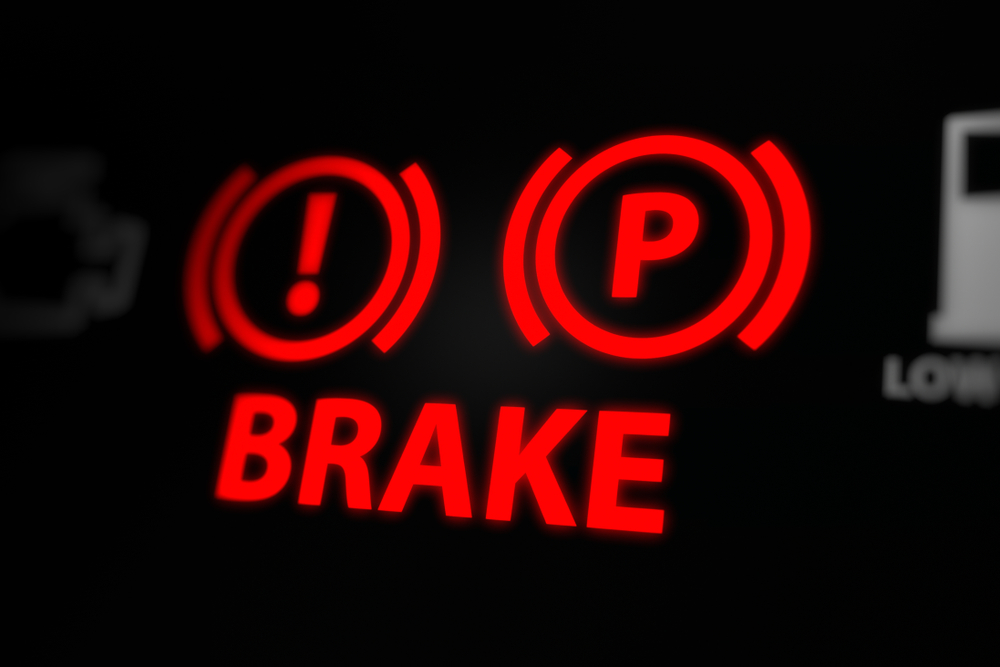
Most cars have two brake warning lights. The red BRAKE light usually comes on for the parking brake, low brake fluid, or a hydraulic fault. The amber ABS light points to a problem with the anti-lock braking system. Which light is on, and why, tells you how urgent it is.
Red BRAKE light with the parking brake off: check the brake fluid level straight away. The reservoir is under the hood, usually near the master cylinder, with min and max marks on the side. Low fluid can come from normal wear, since brake fluid absorbs moisture, or from an active leak. If the level is at or below the minimum mark, don't drive the car until it's been inspected. Topping it up without finding out why it was low doesn't solve anything. If there's a leak, extra fluid only postpones finding it until the brakes fail.
Amber ABS light only, no red BRAKE light: your normal brakes still work. The ABS has a fault, and the anti-lock function is switched off. You'll stop as usual, but in a hard stop the wheels can lock, and you won't have the steering control ABS normally gives you in an emergency. That's a real loss of safety, so get it looked at within a week or two. For most drivers in normal conditions, though, it isn't a reason to stop driving immediately.
Both lights on: treat it as a serious hydraulic fault. Get it inspected right away, and don't drive until you know what set off both lights.
Sign 7: Burning Smell After Driving (Urgency: Moderate to High)
A sharp, acrid burning smell after a drive, especially after steep downhill stretches or heavy traffic, can mean your brakes have overheated. That happens when a caliper seizes or when the brakes are used too heavily, such as riding them down a hill. If you smell it and the car has been stopping normally, park and let the brakes cool for 15 minutes before you look.
Walk around to each wheel carefully, because they can be very hot, and see whether one is much hotter than the rest. If one wheel is scorching while the others are warm or cool, that corner almost certainly has a dragging or seized caliper that has been clamping the whole time. Don't drive until that caliper is fixed.
If the smell follows a mountain descent where you leaned on the brakes the whole way down, that's expected. Let them cool completely before driving normally, and go easy on them until they have. On long descents, shift to a lower gear and let the engine hold your speed; that's the standard advice for avoiding this kind of overheating.
Repair Costs by Component in 2026
| Repair | DIY Parts Cost | Shop Total (Parts + Labor) | Urgency If Needed |
|---|---|---|---|
| Brake pads (one axle) | $25–$80 | $150–$300 | Schedule within 2 weeks |
| Brake pads + rotors (one axle) | $80–$200 | $250–$550 | Schedule this week |
| Caliper replacement (one side) | $80–$200 | $250–$500 | Schedule this week |
| Master cylinder | $60–$150 | $250–$450 | Do not drive |
| Brake line repair | $20–$60 | $150–$350 | Do not drive |
| Full brake fluid flush | $15–$25 | $80–$150 | Every 2–3 years |
| ABS sensor replacement | $25–$80 | $150–$350 | Within 2 weeks |
How Long Brakes Last
How long pads last depends a lot on how you drive, what the pads are made of, and how often you brake. On average, front pads last 30,000 to 70,000 miles and rear pads 40,000 to 80,000. The rears usually outlast the fronts because the front brakes do most of the stopping. Performance cars with big brakes and soft pads may only get 20,000 miles out of a set of front pads. At the other extreme, a gentle city driver in a hybrid with regenerative braking can go past 100,000 miles on the originals.
Rotors usually last through one or two sets of pads, which works out to roughly 60,000 to 120,000 miles for standard cast iron rotors in normal use. Slotted or drilled performance rotors shed heat better but can crack sooner if they're driven hard.
Driving Habits That Destroy Brakes Faster
Two-foot driving is a big one. Resting your left foot lightly on the brake while your right foot works the gas keeps the calipers partly clamped, so the pads heat up, wear down, and glaze the rotors without slowing the car in any useful way. It's common among some new drivers and people who drive automatics, and it can take 40% or more off brake life. Use your right foot for both pedals.
Riding the brakes downhill is the other habit that wears brakes out. Light, steady pressure on the pedal builds heat continuously, and the brakes never get the cooling breaks they get in normal stop-and-go driving. On a downhill stretch, use engine braking as your main speed control. Pick a lower gear, or use the paddle shifters if your automatic has them, and save the brakes for actual stops.
The rule that prevents most brake emergencies
Have your brakes visually inspected every 12,000 miles or once a year, whichever comes first. Ask for it by name; don't assume it's part of every oil change. Caught at 30% pad life, you've got 10,000 to 20,000 miles to plan and budget for new pads. Caught at 5%, you've got about a week. Most shops do the inspection for free, and it takes around 20 minutes.
Brake Fluid: The Maintenance Item Nobody Discusses
Brake fluid is hygroscopic, which means it pulls moisture from the air through the rubber hoses and seals in the system. The more water it holds, the lower its boiling point gets. Fresh DOT 4 fluid boils at 446°F (230°C). With 3% water, which is typical after 3 to 4 years, that drops to about 311°F (155°C). Hard or long braking, which is when you most need your brakes to work, can push fluid temperatures up to or past that lower boiling point. Boiling fluid forms gas bubbles in the lines, and gas compresses where liquid doesn't. The pedal suddenly goes soft right when you're braking hardest. This is called vapor lock.
Most automakers recommend new brake fluid every 2 to 3 years no matter how many miles you've driven, yet most drivers never have it done until something feels wrong. A full flush costs $80 to $150 at a shop. Doing it yourself costs $15 to $25 for fluid plus a bleeding kit for $15 to $40. If you drive in the mountains, tow, or take the car on track days, skipping it can have serious consequences. For everyday commuters the risk is smaller, but it's still there. Adding a brake fluid change to your schedule every three years is cheap, easy maintenance, and a brake failure would cost far more.