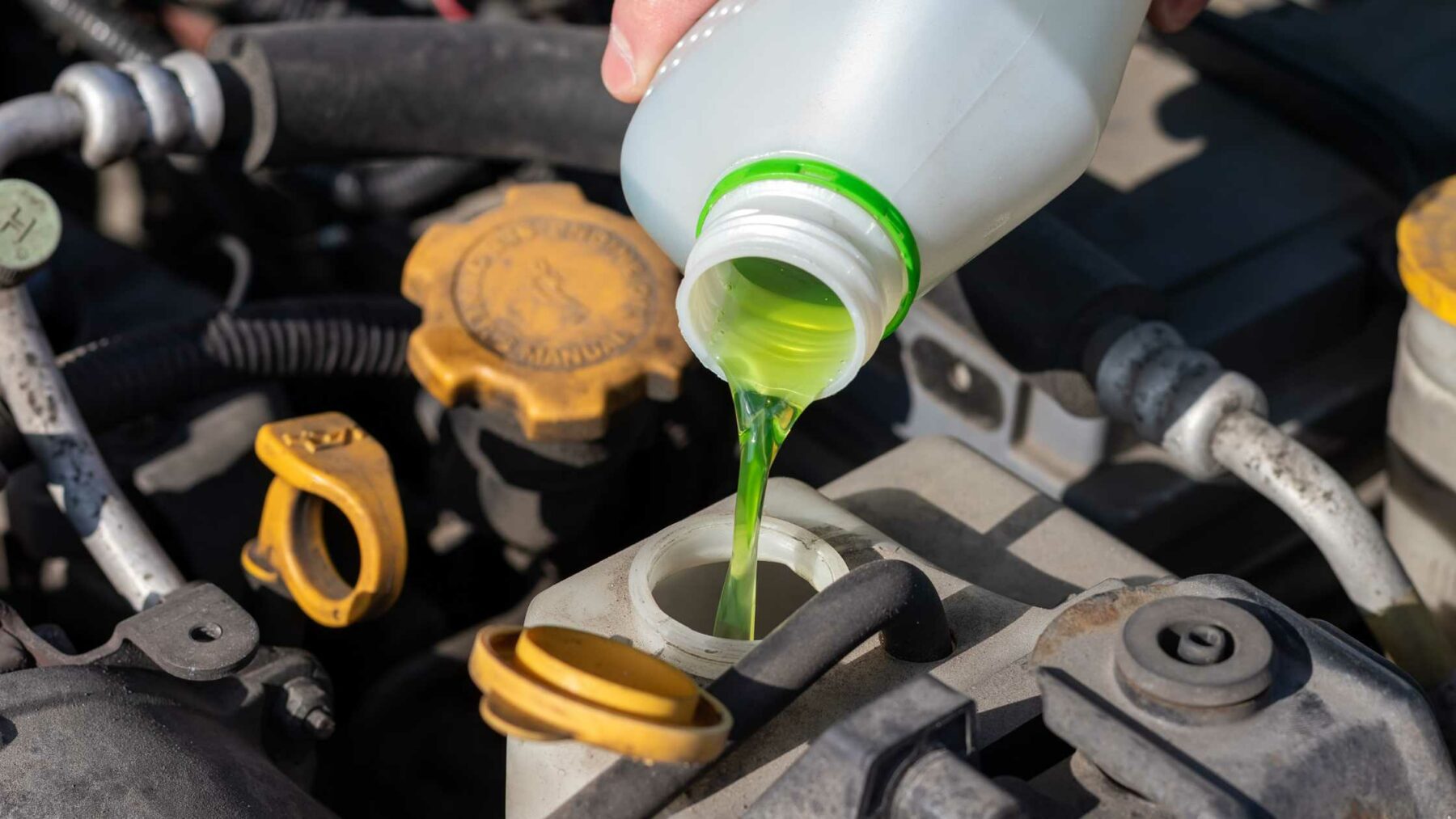
Most drivers know their oil needs changing, and plenty know brake pads wear out. Hardly anyone thinks about coolant until the temperature needle starts climbing on a hot day in traffic. By then, the job they skipped for three years has turned from a $30 DIY task into a $1,500 repair.
Coolant does three jobs. It keeps the engine from overheating by carrying heat from the block to the radiator. It keeps the system from freezing in cold weather by lowering the fluid's freezing point. And it protects every metal part it touches from corrosion, including the radiator, heater core, water pump, and the passages inside the engine block. When coolant wears out, that last job is the first to go. The fluid still flows, so the engine doesn't overheat right away, but corrosion quietly starts eating into parts that cost hundreds or thousands of dollars to replace.
Flushing coolant yourself costs $20 to $40 in parts, or $100 to $200 at an independent shop. The parts it protects cost $500 to $2,500 to replace when corrosion finally gets them. Staying on schedule is an easy call.
What Coolant Does Inside Your Engine
A typical engine runs at 195 to 220°F. That heat comes from combustion, and if nothing carried it away, parts would start warping within minutes. The cooling system is what lets the engine run at those temperatures all day without damage.
Coolant flows through passages in the engine block and soaks up heat from the metal. It then heads to the radiator, where air passing through pulls the heat out before the coolant goes back to the engine for another lap. The water pump keeps it moving, and the thermostat controls temperature by deciding when coolant is allowed to flow to the radiator.
Modern antifreeze does more than stop freezing. Its corrosion inhibitors protect the metal and rubber parts it touches. Without them, the water in the mix would slowly attack aluminum, copper, and rubber from the inside. Those inhibitors get used up over time and with every heat cycle, which is why coolant has a service life and doesn't last forever.
A basic drain and refill only gets out about 60 to 70% of the old coolant. The rest stays in the engine block, the heater core, and the hoses. A proper flush runs clean water or a flushing solution through the whole system to push more of the old fluid out before the fresh coolant goes in. That difference is important if your coolant is dirty or acidic, because a partial change leaves some of the corrosive old fluid behind.
The Three Types of Coolant and Why Mixing Them Is a Serious Problem
Lots of guides skim over this part, and getting it wrong damages engines. There are three main families of coolant in use, and they don't play well together. Mixing them can create sludge that clogs coolant passages and wears out water pump seals. Even when it doesn't, the mix loses the long-life protection each type was designed to give.
IAT (Inorganic Additive Technology): Traditional Green
This is the old-school green coolant. It uses silicates and phosphates to fight corrosion and was standard in most cars built before the late 1990s. Very few new cars use it today. Silicates wear out quickly, so it only lasts about two years or 30,000 miles, which is where the old "flush every two years" advice came from. If your car calls for green IAT coolant, that's what it needs.
OAT (Organic Acid Technology): Orange, Red, or Pink
OAT is extended-life coolant, usually good for five years or 100,000 to 150,000 miles. GM's orange Dex-Cool is the best-known example, and Toyota's pink Super Long Life Coolant is closely related. Many other brands use OAT-type formulas in a range of colors. Instead of silicates, OAT relies on organic acids for corrosion protection, and those wear out much more slowly. The long service life is real.
HOAT (Hybrid Organic Acid Technology): Yellow, Turquoise, or Blue
HOAT combines a small dose of silicates with organic acids. European makers like BMW and Mercedes use it widely, and Chrysler and Ford have used it in some models. Its service life falls between IAT and OAT, often three to five years, though some newer versions last longer. Volkswagen and Audi's G12++ and G13 are a related "silicated OAT" style, and many Asian brands use phosphate-based versions. Each has its own chemistry and compatibility rules.
The rule doesn't bend. Check the owner's manual or the label on the coolant reservoir and use exactly the type it lists. Don't go by color, because different brands use the same color for different chemistries. A red OAT coolant from one maker isn't the same as a red coolant from another. If you're not sure what's in the system, drain it fully and refill with the manufacturer's own coolant from a dealer, and the compatibility risk goes away. OEM coolant usually costs $15 to $25 a gallon. Saving $10 with the wrong jug is how people end up with an $800 heater core bill.
Six Warning Signs Your Coolant Needs Attention Now
Coolant trouble rarely makes itself obvious until the damage is done. Here are the signs to act on before the temperature gauge does the warning for you.
1. Discolored or murky fluid in the reservoir. Fresh coolant is bright and see-through, whatever its color. If it's gone brown, rusty, or cloudy, it's full of corrosion. That doesn't just mean the coolant is old. It means corrosion is happening inside the system right now, and those particles are metal coming off your radiator, heater core, or water pump. Brown coolant means flush it now, not soon.
2. A sweet smell from the vents or under the hood. Coolant smells sweet. If you smell it inside the car, coolant is probably leaking from the heater core. If you smell it under the hood, it's leaking from a hose, the radiator, or the reservoir. Either way, get it checked right away.
3. The reservoir level keeps dropping without visible external leaks. If you top it up and it's low again a few hundred miles later with no puddle under the car, the coolant is going somewhere it shouldn't. The two worrying possibilities are a head gasket leak, where coolant gets into the cylinders and leaves as steam out the exhaust, and a leak into the engine oil. Both need a professional diagnosis before they turn into engine failure.
4. Weak heater performance in cold weather. A heater that struggles to warm the car, especially on cold mornings, often points to poor coolant flow. When sludge or corrosion partly blocks the heater core, not enough hot coolant gets through to heat the cabin. This usually creeps up over time, so many owners just decide their car "doesn't heat very well" and never connect it to maintenance.
5. Coolant pH dropping toward 7 on a test strip. Coolant test strips cost about $5 at any parts store and take ten seconds. With the engine cold, dip a strip in the reservoir and compare the color to the chart on the pack. Healthy coolant usually reads somewhere around 8 to 11, depending on the type. If it's sliding down toward 7, the inhibitors are used up and the coolant is starting to attack the system. It's the most objective early sign that a flush is due.
6. Temperature gauge running higher than normal. If your gauge normally sits in the middle and starts reading higher, particularly in traffic or on long climbs, the cooling system is losing its edge. Worn-out coolant that doesn't carry heat as well, partial blockages from corrosion, and an aging water pump can all cause it. Deal with it before the needle ever gets near the red.
When to Flush: Intervals by Vehicle Type
| Vehicle Type / Coolant | Standard Interval | Severe Service |
|---|---|---|
| Pre-2000 vehicle (IAT/green) | 2 years or 30,000 miles | 2 years or 24,000 miles |
| Modern gasoline (OAT coolant) | 5 years or 100,000 miles | 3 years or 60,000 miles |
| Toyota / Lexus (SLLC pink) | 10 years or 100,000 miles | 5 years or 60,000 miles |
| European (HOAT / VW G12++, G13) | 3-5 years or 50,000 miles | 3 years or 30,000 miles |
| High-performance / track use | 1-2 years regardless of mileage | Every season |
| Any vehicle, brown or murky fluid | Immediately | Immediately |
Some conditions wear coolant out faster: regular towing or hauling, lots of stop-and-go driving in a hot climate, rideshare or delivery work with high daily mileage, and big swings between hot and cold weather. If any of those describe your driving, use the shorter interval.
Start with your owner's manual. Its interval is based on the automaker's testing of that coolant in that engine under normal use. Follow the manual, and use a pH strip as a real-world check on whether your coolant is wearing out faster than the schedule expects.
How to Check Your Coolant Level and Condition
Checking coolant takes two minutes with a cold engine. Do it whenever you check your oil, roughly once a month or every 1,000 miles.
First, and this is the part you can't skip: only check it when the engine is cold. When it's hot, the cooling system is pressurized, and opening the radiator cap or reservoir can spray scalding coolant at you. Wait at least two hours after driving, or check first thing in the morning before you start the car. Touch the upper radiator hose before you open anything. If it feels even slightly warm, give it longer.
Find the coolant reservoir. On most modern cars it's a white or see-through plastic tank connected to the radiator by a small hose, usually marked with a coolant or temperature symbol. You don't need to open the radiator cap on a modern car; the reservoir is where you check and add coolant.
Look at the level against the MIN and MAX marks on the side of the tank. With the engine cold, it should sit between them. If it's under MIN, add coolant. If it keeps dropping below MIN after you top it up, something is using it up, and you need to track down the leak.
Check the color. As mentioned above, brown or murky coolant needs flushing no matter how long it's been since the last service. Good coolant is clear and bright in its original color, with nothing floating in it.
If you have test strips, dip one following the instructions and read the pH. Some strips also show freeze protection and concentration, which tells you whether the 50/50 mix has been thinned out by people topping up with plain water.
DIY Coolant Flush: Step-by-Step
Most owners who are comfortable with basic car jobs can flush coolant at home. The keys are working on a cold engine, using the right coolant, and bleeding all the air out afterward. Allow 60 to 90 minutes for the whole job.
What you need: the correct coolant for your car (the manual lists the type and capacity, usually 8 to 16 quarts for a passenger car); distilled water, never tap water, since its minerals leave scale inside the system; a drain pan that holds at least 3 gallons; a funnel; basic hand tools to reach the drain valve; and, if you want, a cooling system flush product to run through before the final drain.
Step 1: Confirm the engine is cold. Don't skip this. A warm cooling system is under pressure, and hot coolant can cause serious burns if you open it. Wait at least two hours after the last drive.
Step 2: Locate and open the drain. Put the drain pan under the radiator. Most cars have a petcock drain valve at the bottom of the radiator, though some make you pull off the lower radiator hose instead. Turn the petcock counterclockwise, or loosen the clamp and pull the hose, and let the coolant drain completely. That takes three to five minutes. Draining from the petcock alone won't get everything out; a good amount stays in the engine block and heater core.
Step 3: Run a flush if the fluid is contaminated. Close the drain and add a flush product mixed with distilled water, following the directions on the bottle. Put the radiator cap back on, start the engine with the heater on full, and let it run for as long as the product says, usually about ten minutes. That sends the cleaner through the heater core and engine passages. Shut the engine off, wait until it's completely cool (at least two hours), and drain it again.
Step 4: Prepare the new coolant mixture. Most cars call for a 50/50 mix of coolant concentrate and distilled water. That protects to about -34°F and raises the boiling point to around 265°F. Premixed coolant saves you measuring, but buying concentrate and mixing it with distilled water is cheaper. Again, no tap water; its minerals build up as scale and reduce cooling over time.
Step 5: Refill the system. Close the petcock or reconnect the lower hose. Pour coolant slowly into the radiator filler neck so air can escape, and fill to just below the neck. Then fill the reservoir to the MAX line. Leave both caps off for now.
Step 6: Bleed the air. This is where most DIY coolant changes go wrong. Air pockets stop coolant from flowing properly and can cause hot spots even when the gauge looks normal. Start the engine with the heater set to max heat and the fan on high. With the radiator cap still off, keep an eye on the coolant level. When the thermostat opens, you'll see the level drop as coolant starts to circulate. Keep topping up to hold the level. Carry on until coolant is flowing steadily with no bubbles. Then put the radiator cap on, check the reservoir, and fill it to MAX.
Step 7: Test drive and check for leaks. Take a short drive that includes some highway speed so the engine gets fully warm, and watch the temperature gauge the whole time. Once you're back and the engine has cooled, check the reservoir again. A small drop is normal as the last bits of air work their way out. Top up to MAX and look under the car for drips at any connection you touched.
Step 8: Dispose of old coolant correctly. Coolant is poisonous, and its sweet taste attracts pets and wildlife, so never pour it down a drain or on the ground. Most parts stores, including AutoZone, O'Reilly, and Advance Auto Parts, will take used coolant for recycling for free. Carry it there in a sealed container.
When to Pay a Shop and What to Expect
Some cooling system work belongs at a shop, however handy you are. That includes cars that need vacuum filling instead of gravity bleeding, cars with tricky bleed procedures (some BMWs need a scan tool to run the electric coolant pump), and any car showing signs of a head gasket or water pump problem. In those cases, a simple flush can hide the symptoms while the real problem gets worse.
At an independent shop, a coolant flush usually costs $100 to $200 on most passenger cars. Dealers tend to charge $150 to $300. Prices vary with labor time, the type and amount of coolant, and whether the shop does a machine flush, which pushes fluid through the system more thoroughly than draining by gravity, or a simple drain and refill.
A good shop does more than swap the fluid. It should check the hoses for cracks, soft spots, and swelling near the clamps; test that the radiator cap holds the right pressure and seals properly; check the strength and pH of the new coolant; and look for leaks at every connection. If a shop hands your car back five minutes after a "flush" without looking at the hoses, it was a rush job.
Never open a radiator cap or coolant reservoir on a warm engine. When hot, the cooling system runs at 13 to 16 PSI. Opening it releases that pressure all at once and sprays boiling coolant. Always wait at least two hours after driving, or make sure the upper radiator hose is cold before you open anything.
Cost Comparison: DIY vs Professional
| Service Option | Cost Range | Time Required | Best For |
|---|---|---|---|
| DIY drain-and-refill | $20 to $40 | 60 to 90 min | Scheduled maintenance on a well-maintained vehicle |
| DIY with flush product | $30 to $55 | 2.5 to 3 hrs | Slightly contaminated fluid, first service on unknown history |
| Independent shop, drain-and-fill | $100 to $150 | Drop off, 1 hr service | Owners without tools or time |
| Independent shop, machine flush | $150 to $250 | Drop off, 1.5 hr service | Heavily contaminated systems, older vehicles |
| Dealership flush | $200 to $350 | Drop off, varies | Vehicles under warranty, specialized coolant types |
The Four Most Common Coolant Mistakes
Mixing coolant types. We covered this above, but it's worth saying again because it does real damage. Pouring green coolant into an orange system, or the other way round, doesn't just make the coolant less effective. It can form gel-like deposits that clog the heater core and water pump passages. If you've bought a car and have no idea what coolant is in it, drain it completely and refill with the type listed in the owner's manual.
Using tap water instead of distilled water. Tap water has dissolved minerals, mainly calcium and magnesium, that leave scale on hot metal inside the cooling system. Scale acts like insulation right where heat needs to escape. Over time it cuts cooling efficiency and can eventually block passages. Distilled water costs about a dollar a gallon at the grocery store and avoids the problem entirely.
Skipping the air bleed after refilling. An air pocket blocks coolant flow, so parts of the system can end up without coolant. That can cause hot spots even while the gauge reads normal, because the temperature sensor may not be near the air pocket. Bleed the air out properly after every coolant service.
Treating a coolant flush as a fix for overheating. A flush replaces worn fluid and clears corrosion in a system that otherwise works. If the car is overheating, the cause is usually mechanical: a failed water pump, a stuck thermostat, a cracked radiator, or a head gasket problem. Putting fresh coolant into an overheating engine just gives the real fault fresh fluid to keep cooking. Find the cause first, then flush.
Coolant in Hybrid and Electric Vehicles
Hybrids and EVs use coolant for jobs gas-only cars don't have, and their service needs are different enough to deserve their own section.
Many hybrids have more than one cooling circuit: the normal engine loop plus a separate loop for the inverter and power electronics, and sometimes the battery too. These loops can have their own service intervals. Many Toyota hybrids, for example, have a separate inverter coolant loop that appears as its own line in the maintenance schedule. Putting the wrong coolant in the wrong loop can damage expensive parts, so always check the manual instead of assuming one coolant goes everywhere.
Fully electric cars have no engine to cool, but the battery, electric motors, and power electronics all rely on liquid cooling. EVs such as the Chevrolet Equinox EV and Tesla Model Y use coolant made specifically for EVs. Most don't need regular flushes the way gas engines do, though they still need level checks and eventually some service. Many EV maintenance schedules only list periodic checks of coolant level and freeze protection, with no fixed flush interval. Follow your EV's own schedule and don't apply gas-car coolant intervals to it.
If an EV shows a warning about battery temperature, motor temperature, or thermal management, treat it as urgent. Cooling failures in EVs can damage battery packs that cost thousands to replace. A low coolant warning in an EV is a lot more serious than a low washer fluid reminder.
The Bottom Line on Coolant Maintenance
Coolant is a classic "out of sight, out of mind" item until something expensive fails. Fresh coolant of the right type, on schedule, costs under $50 in parts and about an hour of your time. Replacing a heater core runs $500 to $1,500 in labor alone, before parts. On many modern cars a water pump replacement means removing the timing belt or chain cover, which pushes the bill well over $1,000. A head gasket on a modern aluminum engine starts around $1,500 and often goes higher.
The cooling system is one of the clearest cases in car care where a little prevention reliably heads off big repair bills. Check the reservoir every month. Test the pH once a year. Flush on your manufacturer's schedule. Small habits like these protect some of the most expensive parts in your engine.