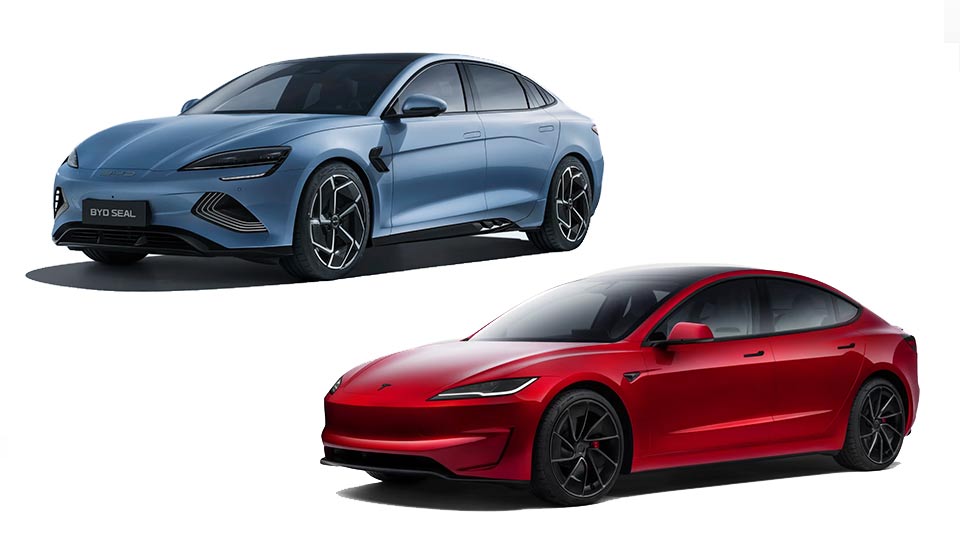
A few years ago, most American drivers had never heard of BYD. Now it's the biggest electric vehicle maker on the planet. Counting plug-in hybrids, it has outsold Tesla for years, and in 2025 it passed Tesla in pure battery-electric sales for a full year for the first time, selling about 2.26 million EVs to Tesla's roughly 1.64 million. For car buyers in much of the world, BYD versus Tesla is no longer a hypothetical question.
There's a catch that shapes this whole comparison: the answer depends heavily on where you live. In the United States, a 100% tariff on Chinese-made vehicles, in place since 2024, plus newer rules restricting Chinese connected-car technology, means BYD doesn't sell passenger cars to American buyers under its own name. In Europe, Australia, Mexico, Southeast Asia, and China itself, BYD and Tesla fight for the same customers every day. We cover both situations here, because the global battle affects every EV buyer, wherever they live.
The BYD Story: From Battery Manufacturer to Global EV Leader
BYD, short for Build Your Dreams, started in 1995 in Shenzhen as a maker of rechargeable batteries. It built its reputation supplying batteries to phone makers like Nokia and Motorola before moving into cars in 2003. For much of the next decade, its cars were decent but forgettable by global standards, sold mostly in China, where government EV subsidies and low manufacturing costs gave BYD an edge Western brands couldn't easily match.
Things started to change in 2008, when Warren Buffett's Berkshire Hathaway bought about 10% of BYD for roughly $230 million. Buffett's partner Charlie Munger famously described founder Wang Chuanfu as a mix of Thomas Edison and Jack Welch. It sounded over the top back then, but it looks pretty accurate now. The investment grew more than twentyfold before Berkshire gradually sold its shares from 2022 and fully exited by 2025. Along the way, it told the world BYD meant to become a global technology company, not just a regional carmaker.
The turning point came in 2020 with the Blade Battery. EV battery safety was under a microscope after a string of high-profile fires, and BYD's lithium iron phosphate (LFP) Blade Battery passed a nail penetration test that typical lithium-ion cells often fail. In that test, a steel nail is driven through a cell to simulate a severe puncture. Many NMC (nickel manganese cobalt) cells go into thermal runaway and catch fire. The Blade Battery didn't. It was a real technical achievement, not a publicity stunt, and it helped push other automakers, Tesla included, to use more LFP batteries in their cheaper models.
BYD's growth since then has been staggering. It sold about 1.86 million "new energy vehicles" (EVs plus plug-in hybrids) in 2022 and about 3.02 million in 2023, when Tesla delivered 1.81 million cars. In 2024, BYD hit about 4.27 million while Tesla delivered about 1.79 million, and in 2025 BYD sold around 4.6 million. The gap keeps widening. Sheer volume matters a great deal in this business, because it drives down manufacturing and parts costs and pays for research.
BYD's US Market Position in 2026: The Tariff Wall
Thanks to Section 301 tariffs, first imposed in 2018 and raised to 100% on Chinese EVs in 2024, BYD sells no passenger cars in the US under its own brand. Newer federal rules that restrict Chinese software and hardware in connected vehicles add another barrier. That's not because BYD lacks cars that could compete here. Models like the Seal, Han, and Atto 3 would be priced right against Tesla's lineup. It's because a 100% tariff on top of the cost of building them makes them far too expensive next to American-built or allied-built competitors.
BYD has looked at ways around the wall. It talked publicly about building a plant in Mexico, but those plans stalled amid trade tensions, and no BYD passenger cars built in North America have reached US buyers. For now, any real BYD presence in the US looks years away and depends as much on politics as on BYD's own plans.
What it means for US buyers today: you can't buy a BYD at an American dealership. But the pressure BYD puts on Tesla around the world still shapes prices and features here. Aggressive BYD price cuts abroad have coincided with Tesla trimming prices and launching cheaper trims, and American buyers have benefited from that competition, even if indirectly.
Head-to-Head: Where BYD and Tesla Compete
Where the two brands go head to head, the comparison gets interesting. The closest match is the BYD Seal against the Tesla Model 3, two similar sedans chasing the same buyers in Europe, Australia, and China.
The BYD Seal AWD in its global form uses an 82.56 kWh LFP battery and has a WLTP range of roughly 520 km. That's about 325 miles on the WLTP cycle, which usually translates to around 270 to 290 miles in real driving. The Seal uses BYD's Cell-to-Body design, where the battery pack forms part of the car's structure instead of just sitting in it. That adds stiffness and saves weight at the same time, a trade-off that usually takes more complicated engineering.
The Tesla Model 3 Long Range AWD has a larger usable battery and an EPA range of around 340 miles, noticeably more than the Seal once you convert between test standards. Tesla's range edge comes from efficient motors, careful battery management, and very good aerodynamics, with a drag coefficient around 0.23 on the Model 3.
In Europe, the Seal usually undercuts a similar Model 3 by 10 to 20%, depending on the version. In Australia, where both sell well, the Seal has often listed a few thousand dollars below the equivalent Model 3. That's a real difference, but not a huge one. BYD's price pressure is much stronger lower down the range, where cars like the Dolphin, Seagull (sold as the Dolphin Surf in Europe), and Atto 3 undercut anything Tesla offers and have won big market share in price-conscious markets.
Battery Technology: Blade Battery vs Tesla's 4680 Cells
This is probably the most interesting technical part of the comparison, and both companies have done impressive work here.
BYD's Blade Battery uses LFP chemistry in long, flat "blade" cells that pack together more tightly than typical cylindrical or boxy cells. LFP gives up some energy density compared with NMC, but it's more stable when hot, lasts for more charge cycles, and holds up better in abuse tests like the nail penetration test. An LFP pack typically lasts 2,000 to 3,000 full cycles before falling to 80% capacity, compared with 1,000 to 1,500 for many NMC cells. In practice, you can charge most LFP-equipped EVs to 100% regularly without much extra wear, while NMC-based EVs are usually best kept to about 80% for daily use.
Tesla's 4680 cells, first used in Model Ys built in Texas from 2022 and later in the Cybertruck, take a different path toward higher energy and lower cost. The 4680 is a large cylindrical cell, 46mm wide and 80mm tall, with a "tabless" design that spreads heat more evenly, which helps with fast charging and high power output. At its 2020 Battery Day, Tesla said the 4680 would hold five times the energy and deliver six times the power of its older, smaller 2170 cells, while costing less to make. Ramping up production proved harder than Tesla expected, and independent analysts have been more cautious about how big the real-world gains are.
Both technologies are real engineering advances, but they're solving different problems: BYD is focused on safety and longevity, Tesla on energy density and charging performance. For most buyers, the day-to-day difference in today's cars is smaller than the technical debate suggests. Where it does show up is in cold weather (LFP loses more range in the cold), in peak fast charging speeds (NMC cells have traditionally charged faster, though BYD's newest platform changes that), and in long-term wear (LFP holds its capacity better over very high mileage).
Software and the Driving Experience: Tesla's Biggest Moat
Software is where Tesla's lead is clearest and most likely to last, at least outside China. Tesla has been building its over-the-air update system since the Model S launched in 2012, and it's now a real competitive advantage. Tesla cars get better over time. New features show up, existing ones improve, and the energy management that controls range and charging keeps getting tuned using data from millions of cars. Owners regularly notice better range estimates, smoother regenerative braking, and smarter navigation, all delivered through software with no visit to a service center.
BYD's DiLink infotainment and vehicle control system is solid by mainstream standards. Its rotating center screen, found on models like the Han, is a distinctive idea that works well in practice, and recent BYD models get over-the-air updates. Outside China, though, those updates are less frequent and less ambitious than Tesla's. The gap isn't just about how the software works today. It's about the organization and data systems that let Tesla keep improving it.
Tesla's Full Self-Driving (Supervised) system, whatever you think of the name or how it's rolled out, represents a huge data advantage and engineering investment that few automakers can match. BYD offers standard driver assistance, including lane centering, adaptive cruise, and automatic emergency braking, and in China it has rolled out its "God's Eye" advanced driver assistance across much of its lineup. In most export markets, though, BYD's driver assistance doesn't match what Tesla offers. If advanced driver assistance matters most to you, Tesla still has the edge in most countries.
Tesla also shines at linking navigation and charging. Enter a destination and the car works out whether you need to charge, sends you to the best Supercharger, and warms the battery on the way. In BYD's markets, public charging varies a lot in quality and in how well it ties into the car. In China, BYD's biggest market, fast chargers are everywhere. Outside China, BYD owners use the same third-party networks as other non-Tesla EVs.
Build Quality: The Honest Assessment
Tesla's build quality has long been uneven. Early Model 3s from roughly 2017 to 2020 were widely criticized for inconsistent panel gaps, paint flaws, and misaligned interior trim. Tesla fixed many of those problems in later production, and newer cars are much better. But the reputation has stuck, and quality surveys have often placed Tesla below average.
BYD's build quality has come a long way since before 2020, and many independent reviewers now consider it on par with mid-range European brands. The Seal's panel gaps are consistent, its interior materials suit its price, and its fit and finish in recent production compares well with a similar Model 3. The flagship Han has an interior that can stand next to entry-level German luxury sedans. Reviewers in the UK and Australia who've driven both regularly say BYD's quality has caught up, while Tesla's can still vary from car to car.
BYD tends to beat Tesla on refinement, meaning noise, vibration, and harshness. The Han and Seal are generally rated quieter at highway speeds than the equivalent Teslas. That reflects different priorities: BYD's Chinese customers have long put a premium on cabin comfort, something Tesla's performance-and-tech-focused approach didn't prioritize at first.
Charging Networks: Tesla's Structural Advantage
Outside China, Tesla's Supercharger network is the best public fast charging network around. Tens of thousands of stalls worldwide, with much better reliability than most rival networks, make long trips in a Tesla far easier than in most other EVs that rely on third-party charging. Tesla has opened many Superchargers to other brands, in North America since 2024 and earlier in parts of Europe, which helps all EV drivers while keeping Tesla's name tied to dependable charging.
China is a different story. BYD's home market has a huge network of fast chargers run by companies like State Grid and TELD, and BYD is building its own ultra-fast stations too. In big Chinese cities, fast chargers are as common as Superchargers in US metro areas, or more so. For BYD buyers in China, charging isn't much of a disadvantage against Tesla.
Charging speed deserves a closer look, because BYD has leapfrogged here. Popular export models like the Seal peak at around 150 kW, while Tesla's newer cars can take up to 250 kW at Superchargers, so on a road trip a Model 3 usually spends less time plugged in than a Seal. But in March 2025, BYD unveiled its Super e-Platform, capable of charging at up to 1,000 kW (1 megawatt), enough for about 400 km (roughly 250 miles) of range in around five minutes at BYD's own megawatt chargers. It went on sale first in the Han L and Tang L in China, and BYD has announced plans to bring megawatt chargers to Europe. For now, that speed is limited to specific new models and BYD's own stations, but it shows how fast BYD is moving.
What the Next Three Years Look Like
BYD's megawatt charging platform is its boldest move yet. If it spreads to more models and markets, charging stops could become about as quick as filling a gas tank. The big questions are how quickly BYD can build enough megawatt chargers outside China and what those stations will do to local power grids.
In Europe, the EU has added extra duties on Chinese-built EVs, and BYD's rate is at the lower end of the scale. BYD's answer is to build locally. Its factory in Szeged, Hungary, began pilot production with mass production planned for 2026, starting with the small Dolphin Surf, and a plant in Turkey is also planned. In Southeast Asia, BYD already builds cars in Thailand and has become a market leader in several countries.
Tesla's response to cheaper rivals so far has been cheaper versions of existing cars, not an all-new small model. In late 2025 it launched the Model Y Standard and Model 3 Standard in the US, trimming features to cut prices. A truly low-cost Tesla, long rumored at around $25,000, still hadn't gone on sale by mid-2026. Tesla has shifted more attention to autonomy and robotaxis, which could help or hurt its ability to compete with BYD on price.
Who Wins, and Who Should Choose Which Brand
Where both brands compete, BYD usually wins on value: competitive range, strong build quality, a quieter cabin, and the durability and safety of LFP batteries, all for less money. Tesla wins on software, charging network access outside China, sharper driving dynamics (the Model 3 steers and handles more precisely than the Seal), and over-the-air updates that keep improving the car after you buy it.
For US buyers in 2026, the choice is simple: BYD isn't an option. You can't buy one without paying a 100% tariff premium, and the regulatory hurdles make that impractical. Even so, BYD's global competition pushes Tesla and other automakers toward lower prices and faster development. If US trade policy changes, or BYD eventually builds cars in North America in a way that qualifies, all of this could change quickly. BYD's global pricing suggests it could compete hard in the $25,000 to $40,000 range.
For buyers in Europe, Australia, or Southeast Asia choosing between the two, it comes down to your priorities. If software, charging access, and easy long road trips matter most, Tesla wins. If value, build quality, battery longevity, and comfort come first, BYD is a very strong choice. Neither is right for everyone. What's clear is that BYD's rise has created real competition, and that competition has given buyers better cars, faster progress, and lower prices across the whole market.
The broader implication
Tesla's days as the unchallenged EV leader are over. BYD is now a true peer, with real technical advantages in some areas, far greater manufacturing scale, and big global ambitions. For EV buyers everywhere, that rivalry is pushing prices down and technology forward faster than any single company could manage alone.