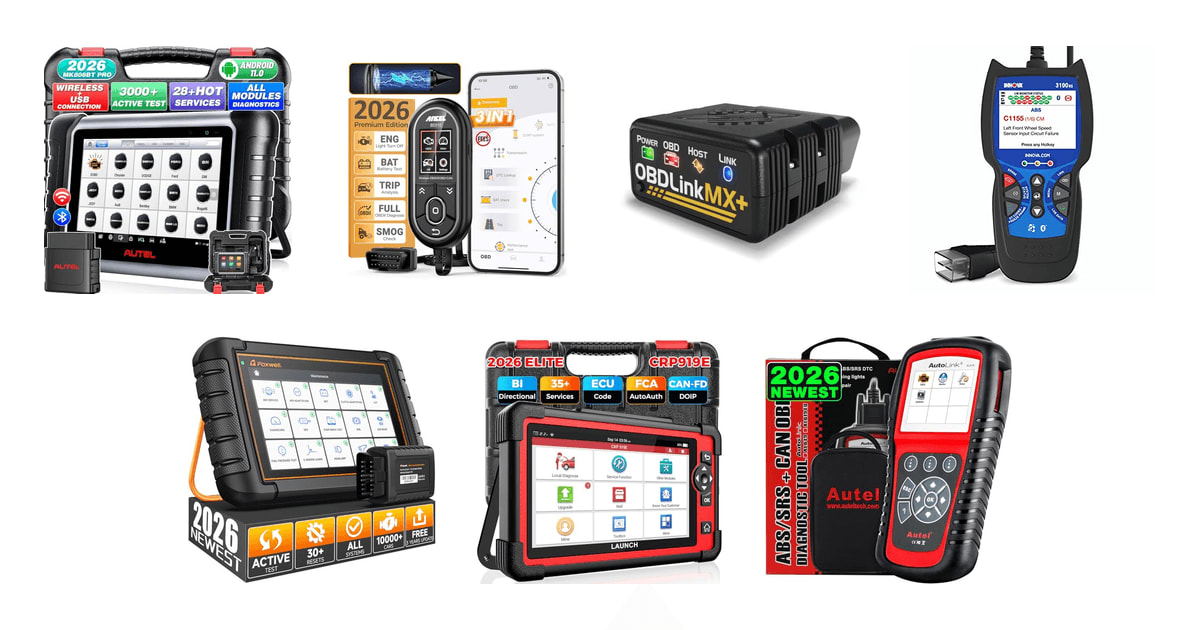
When the check engine light comes on, most drivers do one of two things. They start worrying about a big repair bill, or they pay a shop $50 to $75 just to read the code before any work is done. An OBD2 scanner takes care of that second step. Plug it into the port under the dash, read the code in less than a minute, and you walk into the shop already knowing what the car is complaining about. Prices range widely, and the right pick comes down to whether you only want to read codes or you want to dig deeper into diagnostics.
We judged these seven on how accurately they read codes against known faults, how helpful the app or screen is, the quality of their live data, and whether the price lines up with what the tool can do. That last point counts for a lot here, because few car accessories have a bigger gap between what the box promises and what you get.
How These Were Evaluated
We connected each scanner to vehicles with confirmed fault codes in three groups: emissions codes (the most common reason people buy a scanner), misfire codes, and sensor-circuit codes. For each one we checked whether it read the code correctly, whether it offered anything beyond the bare code (freeze-frame data, likely causes, repair cost estimates), and how clearly its app or screen presented that information.
1. BlueDriver Bluetooth Pro: Best Overall
BlueDriver is still the scanner everything else gets measured against, and the 2026 model keeps it there. It reads generic OBD2 codes plus enhanced, manufacturer-specific codes for most big brands. That's a bigger deal than it sounds, because generic codes often leave out the detailed fault data automakers store for their own dealer tools. The app also has a repair report that shows how often your code comes up on the same make and model among other BlueDriver users, and which fix most often solved it. A code number alone can't tell you that.
Strengths
- Manufacturer-specific enhanced code access on most major brands
- Repair report feature adds useful diagnostic context
- Reliable Bluetooth connection with minimal dropouts
Weak Points
- At roughly $120, the most expensive app-based option on this list
- Requires a smartphone; no standalone display
2. FIXD Sensor: Best for Casual Users
FIXD gives up some depth in exchange for being very easy to use. It turns raw codes into plain English, so instead of "P0420" you get "your catalytic converter is not working efficiently." It's built for drivers who have zero interest in learning what fault codes mean. At about $60, it's a sensible middle option if you want to know what's wrong without learning OBD2 jargon.
Strengths
- Plain-language explanations, no code memorization required
- Affordable relative to enhanced-code competitors
- Simple, focused app with minimal learning curve
Weak Points
- No manufacturer-specific enhanced codes
- Limited live data streaming compared to BlueDriver or Autel
3. Autel MaxiCOM MK808: Best Standalone Device
Most of the scanners here lean on your phone. The MK808 doesn't. It's a self-contained unit with its own 7-inch touchscreen, which is handy if you do regular diagnostic work in a garage and don't want your phone tied up. It also does bi-directional testing on many systems. In plain terms, it can tell parts of the car to do something, like cycle the cooling fan or run an EVAP test, instead of only reading sensor data. That feature usually shows up on pro-level tools.
Strengths
- Fully standalone, no phone required
- Bi-directional testing on many supported systems
- Covers ABS, airbag, and transmission modules as well as the engine
Weak Points
- At roughly $300-400, priced closer to professional equipment than a casual accessory
- Steeper learning curve than app-based competitors
4. Ancel BD310: Best Budget Bidirectional Scanner
The BD310 packs a useful set of bi-directional functions, including battery registration, oil light reset, and throttle body relearn, into a tool that costs about $130. A few years ago you'd have paid a lot more for that. Its system coverage isn't as wide as the Autel MK808's. Still, for the resets home mechanics run into after routine jobs, like clearing an oil change reminder or registering a new battery, it handles the common stuff for a fraction of the price.
Strengths
- Real bi-directional functions at a budget price point
- Covers the service resets most DIY owners need
- Standalone color display
Weak Points
- Narrower vehicle coverage for bi-directional functions than Autel
- Interface feels dated compared to app-based competitors
5. LAUNCH CR319: Best Ultra-Budget Option
For around $30, the CR319 reads and clears generic OBD2 codes and does it reliably. That's all it does. There's no subscription, no app that wants you to create an account, and the built-in screen is easy to follow. It suits someone who wants to check a warning light once in a while or clear a code after a small fix, and doesn't need more.
Strengths
- Lowest price on this list with reliable core functionality
- No app, account, or subscription required
Weak Points
- Generic codes only, no manufacturer-enhanced data
- No live data streaming or freeze-frame detail
6. Topdon ArtiDiag 600: Best for Multi-System Coverage on a Budget
The ArtiDiag 600 fits between the cheap code readers and the Autel. For about $90 it reads ABS, SRS (airbag), transmission, and engine systems, while most basic readers only see powertrain codes. If you want to chase down an airbag or ABS light without booking a shop visit, nothing else at this price does as much.
Strengths
- Multi-system coverage (ABS, SRS, transmission) at a mid-tier price
- Standalone display, no phone required
Weak Points
- No bi-directional testing
- Software updates require a computer, not just the device itself
7. Innova 3100RS: Best for Live Data Enthusiasts
The 3100RS keeps code reading simple and adds very good live data. Sensor readings show up as graphs instead of columns of numbers, so an intermittent fault, like a sensor that spikes for a second under load, is much easier to spot. At about $100, it's for owners who want to watch a suspected problem during a test drive, not just pull a code after it's happened.
Strengths
- Strong live data graphing, useful for intermittent issues
- ABS code reading in addition to standard powertrain codes
Weak Points
- No manufacturer-enhanced codes beyond generic OBD2
- App interface less polished than BlueDriver's
Which One Should You Buy?
If you mostly want to understand a check engine light before deciding whether to see a mechanic, get the BlueDriver, even though it costs more. Its enhanced codes and repair reports will save you more in skipped diagnostic fees over the years than the extra it costs up front. On a tight budget and only need to read codes? The LAUNCH CR319 is great value. If you do your own maintenance, the Ancel BD310's service resets are the reason to buy it. And if you work on several cars regularly or want a tool that doesn't need a phone, the Autel MK808 is worth its higher price.
Any scanner here pays for itself the first time it saves you a $50 to $75 diagnostic fee. So the question isn't whether to buy one. It's how much extra depth you want on top of that. For most people, the sweet spot sits between the $30 basic reader and the $120 BlueDriver, well short of the $300-plus professional tools.